

If you’ve scrolled through TikTok or Instagram lately, you’ve probably seen someone describe their brunch, their outfit, or their entire vibe as “boujee.” But what does boujee actually mean, and where did it come from?
In short, Boujee Mean is slang for someone or something that looks or feels luxurious, high-class, or fancy often with a hint of “new money” pride rather than old-school wealth. It comes from “bourgeois,” the French word for the middle class, and it’s been reshaped by Black American culture and hip-hop into the word millions of people use today. Below, we’ll break down its origin, its meaning, how it’s different from “bougie,” and how to actually use it in a sentence.
From French Bourgeoisie to American Slang
The word traces back to the 16th-century French term bourgeoisie, which referred to townspeople merchants, traders, and craftsmen who lived inside city walls. The term comes from the French word “bourg,” meaning a small market town or walled settlement, and people who lived in these towns were known as the bourgeois.
Over time, the meaning shifted. By the 18th century, “bourgeois” had become associated with the middle class people who weren’t aristocrats but weren’t poor either. In Marxist theory, the term took on a sharper edge, describing the property-owning capitalist class as opposed to the working class.
How “Bougie” Entered Black American Slang
Here’s where things get interesting. In the 1960s, “bougie” emerged from African American English as a shortened, altered version of “bourgeois,” initially used to criticize wealthier or upwardly mobile Black people who were viewed as acting overly middle-class. It wasn’t a compliment it was a callout, often aimed at people accused of putting on airs or distancing themselves from their roots.
By the 1970s, “bougie” had become an established piece of slang, used to mock people or things seen as overly consumeristic, pretentious, or suburban.
Boujee: The 2016 Glow-Up
The spelling “boujee” and its slightly softer, more celebratory meaning really exploded thanks to one song. In 2017, the hip-hop trio Migos released “Bad and Boujee,” a track celebrating the experience of being newly rich and successful while still keeping it real. The song (technically released in late 2016, but a chart-topper into 2017) gave the word a massive cultural platform and introduced a new spelling that stuck.
Unlike the older, more critical “bougie,” this version of “boujee” leaned positive it was about earning your glow-up, not faking one.
Boujee Meaning, Pronunciation, and Definition
So what does boujee actually mean today, in plain English?
Boujee (adjective): describing someone or something as fancy, luxurious, high-class, or flashy often implying status, indulgence, or a taste for the finer things.
It can describe:
- A person’s lifestyle or attitude
- An outfit, accessory, or aesthetic
- A restaurant, hotel, or vacation
- A general “vibe” of exclusivity or extra effort
Boujee Meaning Pronunciation
This is one of the most searched questions about the word, and it makes sense the spelling doesn’t exactly scream “easy to say.”
| Word | Pronunciation | Sounds Like |
| Boujee | BOO-jee | “booj” + “ee” |
| Bougie | BOO-zhee | “boozh” + “ee” |
| Bourgeois | boor-ZHWAH | French-style “zh” sound |
The key difference: boujee uses a soft “j” sound (like the “j” in “jeep”), while bougie uses a “zh” sound (like the “s” in “treasure”). Once you hear the difference, it’s easy to keep straight.
Boujee Meaning in English (Simple Definition)
If someone asks “what is the meaning of boujee in English,” here’s the simplest way to put it: it means fancy, upscale, or extra, often associated with looking or feeling more well-off than the average person.
It’s typically used as a descriptive adjective, though it occasionally pops up as a noun referring to a high-class lifestyle in general (“living the boujee life”).
Boujee vs. Bougie: Clearing Up the Confusion
This is hands-down the biggest point of confusion people have. Are “boujee” and “bougie” the same word? Mostly but with a subtle twist.
| Feature | Bougie | Boujee |
| Origin | Direct shortening of “bourgeois” | Spelling popularized by Migos’ 2016 song |
| Tone | Often disparaging or judgmental | Often positive or celebratory |
| Typical meaning | Pretending to be high-class; “old money” pretension | Genuinely living a lavish, “new money” lifestyle |
| Common use | “She’s acting so bougie” (insult) | “That dinner was so boujee” (compliment) |
| Pronunciation | BOO-zhee | BOO-jee |
The clearest way to remember it: bougie often implies someone is putting on a front acting wealthier than they really are. Boujee, especially after the Migos song, leans toward someone who’s actually living well and isn’t shy about it.
That said, in everyday conversation, plenty of people use the two interchangeably, and dictionaries note that the lines have blurred. Context and tone of voice usually makes the intended meaning clear.
Boujee Meaning Urban Dictionary
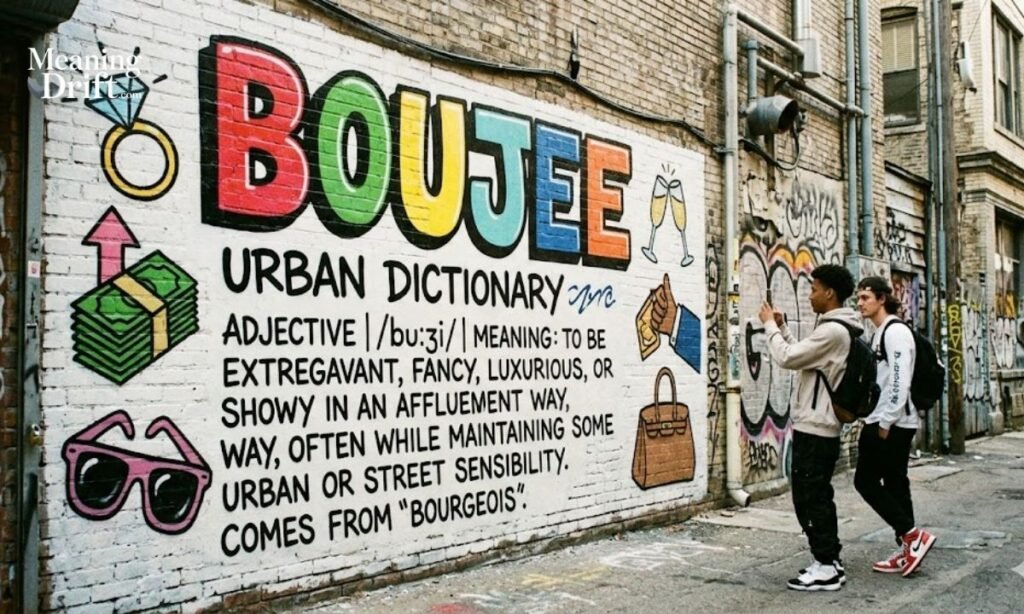
Urban Dictionary, as you’d expect, offers a rawer, more informal take. Common definitions there describe boujee as someone living a high-class lifestyle, often tied to luxury items, designer brands, and an “I’ve made it” attitude. Some entries lean more critical, describing boujee places or people as overly polished, exclusive, or disconnected from everyday life basically the gentrified, “too good for the corner store” version of the word.
The takeaway: even within slang communities, boujee carries both a flex and a side-eye, depending on who’s using it.
Boujee Meaning French Connection
It’s worth circling back to the French root because it explains a lot about how the word feels today.
Both “bougie” and “boujee” ultimately trace back to the 16th-century French term “bourgeoisie,” referring to the emerging merchant class whose wealth gave them new social status. Interestingly, in modern France, “bourgeois” doesn’t carry quite the same flashy connotation it does in American slang.
In France today, being bourgeois is associated with effortless style, good manners, a solid education, and maybe a country house outside the city not the loud, look-at-me wealth that “boujee” often implies in American pop culture. So while the word made the trip across the Atlantic and through centuries of reinterpretation, its modern American slang usage is really its own creation, shaped far more by AAVE and hip-hop than by anything happening in Paris today.
Boujee in Pop Culture and Social Media
You can’t talk about boujee without talking about its biggest cultural moment.
“Bad and Boujee” and the Migos Effect
“Bad and Boujee” by Migos became a major cultural reference point, with the term rapidly spreading through hip-hop and across social media following the song’s massive popularity. The track didn’t just top charts it inspired countless memes built around lines from the song, cementing “boujee” as a household word almost overnight.
Why It Stuck Around
A few reasons boujee has had such staying power:
- It’s versatile. You can call a person, a brunch spot, a candle, or a pair of sneakers boujee.
- It feels aspirational. Unlike purely negative slang, boujee often celebrates upward mobility rather than mocking it.
- Social media loves a flex. Captions like “feeling boujee today” fit perfectly into the visual culture of Instagram and TikTok.
- It’s fun to say. The rhythm and sound of the word make it catchy, almost playful.
Today, you’ll see #boujee used on everything from skincare routines to home décor reveals to vacation photos a word that started as social commentary has become a lighthearted lifestyle tag.
Also Read This:What Does SYBAU Mean? Origin, Examples, Variations and More
Everyday Usage and Examples of Boujee
Wondering how to actually drop “boujee” into conversation without sounding off? Here are some natural, real-world examples.
Describing a lifestyle:
- “She’s living that boujee life now new apartment, new car, the works.”
- “I want to buy a plane to live that boujee life.”
Describing food or drinks:
- “Let’s get boujee tonight and order the tasting menu.”
- “Another way to be boujee on a budget is to shop at discount stores and mix high-end pieces with affordable basics.”
Describing fashion or style:
- “Check out her boujee outfit she’s dressed to the nines.”
- “That diamond necklace makes you look so boujee.”
Describing places:
- “This hotel lobby feels so boujee with all that marble and gold trim.”
“Bad and Boujee” Meaning, Left Off
A lot of people search variations like “left off bad and boujee meaning,” usually trying to recall the exact line from the Migos song or understand what it implies when used alone. In the song, “bad” means good-looking or attractive, while “boujee” describes someone newly successful and enjoying a high-class lifestyle together, the phrase celebrates a partner who’s both stunning and self-made. When people drop just the “boujee” half in captions or conversation, they’re usually borrowing that same energy: confident, glamorous, and proud of it.
Quick Reference: How to Use Boujee Correctly
| Use Case | Example | Tone |
| Compliment | “Your new kitchen is so boujee!” | Positive |
| Self-description | “Feeling a little boujee today, treated myself to brunch.” | Playful |
| Light criticism | “He’s gotten so boujee since the promotion.” | Teasing/mixed |
| Aspirational | “Goal: boujee on a budget.” | Motivational |
Why Boujee Matters Today: Cultural Impact and Future
Boujee is more than just a buzzword it’s a small but telling example of how slang travels. It started as a critique within African American communities, aimed at people seen as forgetting where they came from. Decades later, thanks to hip-hop’s massive cultural reach, it transformed into something many people use proudly to describe success, style, and self-made wins.
This evolution matters because it shows how language shaped by specific communities often becomes mainstream sometimes losing nuance along the way, and sometimes gaining new, more empowering meaning. Boujee’s journey from a pointed insult to a celebratory hashtag reflects broader shifts in how society talks about wealth, identity, and “making it.”
Looking ahead, boujee shows no signs of slowing down. It’s become a fixture in everyday English, especially online, and continues to evolve with each generation that picks it up whether that’s Gen Z reinventing it for new memes or brands using it in marketing to signal “affordable luxury.” Like most slang with real cultural roots, it’ll likely keep shifting in tone and use, but its core idea looking and living like you’ve made it isn’t going anywhere soon.
Frequently Asked Questions
What does boujee mean in slang?
Boujee means fancy, luxurious, or high-class, often describing a person’s lifestyle, style, or attitude.
Is boujee a compliment or an insult?
It can be either often a compliment about living well, but sometimes a light tease about being extra or pretentious.
How do you pronounce boujee?
It’s pronounced “BOO-jee,” with a soft “j” sound, similar to the word “budgie.”
What’s the difference between boujee and bougie?
Bougie often implies someone is faking wealth, while boujee usually celebrates genuinely living a high-class lifestyle.
Where does the word boujee come from?
It comes from the French word “bourgeoisie,” shortened through African American English and popularized by Migos’ 2016 song “Bad and Boujee.”
Can boujee describe things, not just people?
Yes restaurants, outfits, hotels, drinks, and even candles are commonly called boujee.
Is boujee only used in African American English?
It originated there, but it’s now widely used across cultures and age groups, especially online.
Final Thoughts
So, what does boujee mean? At its core, it’s a word about looking and living like you’ve made it whether that’s a five-star vacation, a designer bag, or just treating yourself to a fancy coffee on a Tuesday. Born from French class terminology and reshaped by Black American culture and hip-hop, boujee has grown into one of the most flexible, fun slang words in modern English.
Whether you’re using it to hype up a friend’s new apartment or caption your latest brunch photo, now you know exactly where it came from and how to use it right.

Thomas is the creator of MeaningDrift, a writer guided by curiosity and a passion for meaning. With a background in existential psychology and comparative spirituality, Thomos translates deep questions into clear, compassionate guidance. Their writing invites readers to explore life’s purpose and craft meaning in everyday moments.