

Luxor is the Arabic name for a city in southern Egypt, and it translates to “The Palaces.” It sits on the site of ancient Thebes, once the religious and political capital of Egypt, and today it’s world-famous for the Karnak Temple, the Valley of the Kings, and thousands of years of pharaonic history. In casual conversation, people also use “Luxor” as shorthand for luxury, grandeur, or an unforgettable travel bucket-list destination.
If you’ve scrolled through travel reels, heard someone mention a “Luxor-style” hotel, or seen the word in a history class and wondered what it actually means you’re in the right place. This guide covers where the name came from, why it’s so famous, and how people use it today.
Luxor Meaning – Quick Definition
So, what does Luxor mean?
In the simplest terms, Luxor mean is the modern name of a city in Upper (southern) Egypt, located on the eastern bank of the Nile River. The word comes from Arabic and means “The Palaces” or, by some accounts, “The Forts.”
Here’s the quick breakdown:
| Aspect | Meaning |
| Literal translation | “The Palaces” (from Arabic al-Uqsur) |
| Ancient Egyptian name | Waset, “City of the Sceptre” |
| Greek name | Thebes |
| Modern identity | City in Upper Egypt, UNESCO World Heritage Site |
| Popular meaning | A symbol of ancient grandeur and luxury |
In short, Luxor isn’t just a place it’s a word that carries the weight of one of history’s greatest civilizations.
Origin and Background of the Word Luxor
Historical Evolution
The story of the word “Luxor mean” stretches across three different languages and several thousand years. Tracing it helps explain why the same patch of land has gone by so many names.
Ancient Egypt
Long before “Luxor” existed, this city was called Waset by the ancient Egyptians “City of the Sceptre.” It served as Egypt’s capital during parts of the Middle and New Kingdoms and was home to the god Amun. The Greeks later renamed it Thebes, a name that stuck in Western history books for centuries.
Arabic Influence
The name “Luxor” itself didn’t appear until much later. It comes from the Arabic word al-Uqsur (الأقصر), which means “the palaces” or “the castles.” This name likely referenced the Roman-era fortified camps (castra) built near the ancient temples, since later settlers saw the massive temple ruins and assumed they were palace fortifications.
Modern Recognition
Today, Luxor meaning in English is straightforward: it refers to the city in Egypt that’s home to some of the most significant archaeological sites on Earth. The Arabic name has been adopted into English, French, German, and most other languages with only minor spelling shifts (Louxor, Luksor, Louqsor).
Why Luxor Is So Famous
Luxor isn’t just another city on a map. It’s often called the “world’s greatest open-air museum,” and for good reason roughly one-third of the world’s most valuable ancient monuments sit within its boundaries.
Here’s why people travel from every corner of the globe to see it:
- It was the religious and political capital of ancient Egypt during the New Kingdom.
- It contains Karnak Temple, the largest religious complex ever built.
- It’s home to the Valley of the Kings, where pharaohs like Tutankhamun were buried.
- New archaeological discoveries, including a “golden city” uncovered near the Valley of the Kings, continue to surface here.
- It’s a UNESCO World Heritage Site, protected since 1979.
Major Attractions
| Attraction | What It’s Known For |
| Karnak Temple | Largest ancient religious complex in the world |
| Luxor Temple | Built by Amenhotep III, completed by Tutankhamun and Ramses II |
| Valley of the Kings | Royal burial ground, including Tutankhamun’s tomb |
| Valley of the Queens | Burial site for royal wives and children |
| Hatshepsut Temple | Mortuary temple of Egypt’s most powerful female pharaoh |
| Colossi of Memnon | Massive stone statues guarding the West Bank |
| Luxor Museum | Houses artifacts, mummies, and royal statues |
Real-Life Conversations Using the Word Luxor
Outside of textbooks, “Luxor mean” pops up in everyday digital conversations too usually tied to travel plans, bucket lists, or comparisons to luxury.
WhatsApp Chat
“Guess what? We just booked our Luxor trip for December 😍” “No way! You HAVE to see Karnak at sunrise, it’s unreal.”
Instagram DM
“Where was this photo taken? The temple in the background is stunning” “Luxor! Best three days of my life, honestly.”
Text Message
“This hotel lobby looks like Luxor lol, so extra” “Right? Marble everywhere 😂”
Luxor Meaning Slang / Urban Dictionary
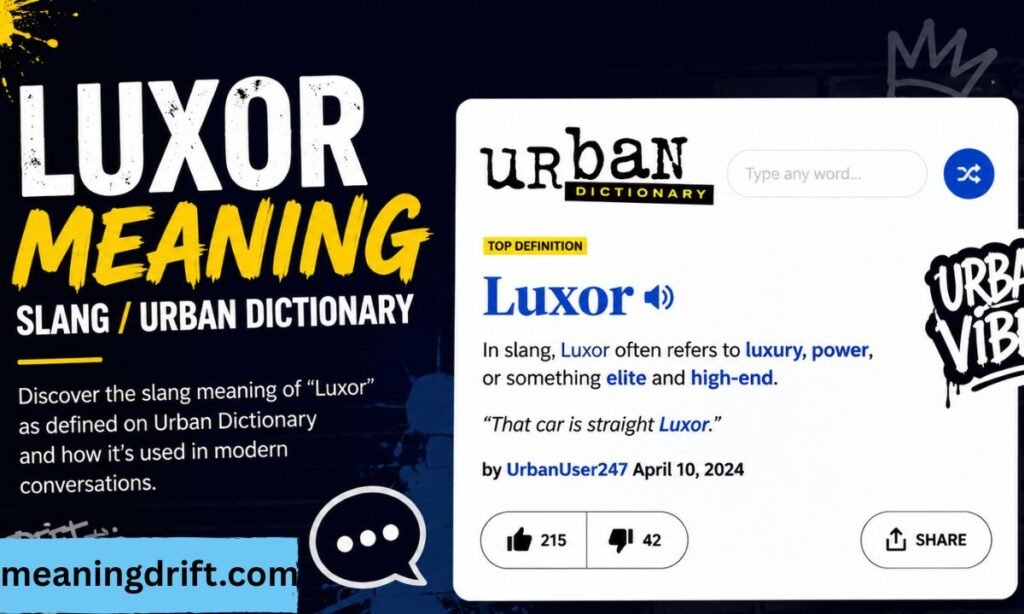
Outside its geographic meaning, some informal usage treats “Luxor” as slang for something opulent, grand, or over-the-top luxurious a nod to the temples and palatial scale the name implies. This isn’t a dictionary-standard definition, but it shows up in casual online slang where people compare extravagant interiors, hotels, or even outfits to “something out of Luxor.”
Emotional and Psychological Meaning of Luxor
Beyond geography, Luxor carries an emotional weight for many people especially travelers, history students, and archaeology enthusiasts.
A Sense of Wonder
Standing among 3,000-year-old columns puts things in perspective. Visitors often describe pure awe the first time they see Karnak’s hypostyle hall or the Valley of the Kings.
Respect for History
Luxor represents what a civilization achieved without modern tools which inspires real respect for ancient engineering and artistry.
Inspiration
Writers, artists, and designers reference Luxor’s symbols sphinxes, obelisks, lotus columns as creative inspiration.
Connection to the Past
Because Luxor preserves so much of its original structure, it offers a rare, tangible link to people who lived thousands of years ago.
Luxor meaning opera: Interestingly, Luxor’s imagery has also influenced the arts. Egyptian-themed sets, costumes, and storylines most famously in operas like Verdi’s Aida have used Luxor’s temples and symbolism as inspiration, cementing the city’s association with grandeur in performance art as well.
Usage of Luxor in Different Contexts
The word adapts depending on where and how it’s used.
Social Media
On platforms like Instagram and TikTok, “Luxor” usually appears as a travel hashtag or a backdrop reference, often paired with sunrise hot-air-balloon photos or temple shots.
Friends and Relationships
Among friends, mentioning Luxor mean often signals bucket-list talk, honeymoon planning, or comparing travel stories.
Also Read This:What Does Boujee Mean? Origin, Evolution, Examples and More
Professional Settings
In academic, museum, or tourism industry contexts, Luxor is used formally referring to historical research, conservation projects, or travel partnerships.
Casual vs Serious Usage
| Context | Tone | Example |
| Casual | Light, descriptive | “This place looks like Luxor!” |
| Serious | Academic, factual | “Luxor was the capital during the New Kingdom.” |
| Travel | Aspirational | “Luxor is on my bucket list.” |
| Slang | Comparative | “That lobby is so Luxor.” |
Common Misunderstandings About Luxor
Despite being a well-known name, a few myths persist.
Mistake 1: Thinking Luxor Is an Ancient Egyptian Word
Luxor is actually Arabic, not ancient Egyptian. The original Egyptian name was Waset.
Mistake 2: Assuming Luxor Refers Only to a Temple
Luxor is a city, not a single temple. The Luxor Temple is just one of many sites within the city.
Mistake 3: Confusing Luxor With a Brand Name
Some people associate “Luxor” only with hotels, casinos, or pen brands that borrowed the name. The original and primary meaning is the Egyptian city itself.
Anchor Text:Finlet Meaning in 2026: Definition, Origin & How People Use It Today
When Not to Use the Term Incorrectly
Avoid using “Luxor” interchangeably with:
- “Egypt” as a whole (Luxor is one city within Egypt)
- “Cairo” (a completely different city and region)
- “Pyramids of Giza” (those are located near Cairo, not Luxor)
Comparison Table
| Term | What It Actually Refers To |
| Luxor | City in Upper Egypt, former Thebes |
| Cairo | Capital city of modern Egypt |
| Giza | Location of the Great Pyramids, near Cairo |
| Karnak | A temple complex located within Luxor |
| Thebes | Ancient Greek name for Luxor |
Key Insight
Luxor’s fame comes from being a city of temples, not a single monument that’s the most important distinction to remember.
Also Read This:What Does SYBAU Mean? Origin, Examples, Variations and More
Variations and Related Uses of Luxor
The word “Luxor” branches into several related terms, each with a slightly different focus.
- Luxor City – the modern urban center on the Nile’s east bank.
- Ancient Thebes – the historical name used by the Greeks for the same location.
- Luxor Temple – a specific temple complex built by Amenhotep III.
- Karnak Luxor – often used together to describe the East Bank’s twin temple sites.
- Luxor Tourism – the broader travel and hospitality industry built around the city.
- Luxor Heritage – references to UNESCO protections and preservation work.
- Luxor Archaeology – ongoing excavation and research projects, including recent discoveries near the Valley of the Kings.
- Luxor Museum – the dedicated museum housing artifacts from the region.
- Luxor Travel Experience – the broader sensory experience of visiting, including Nile cruises and hot-air balloon rides.
- Modern Luxor – the contemporary city with markets, restaurants, and a population of over half a million people.
How to Respond When Someone Mentions Luxor
Not sure how to reply when Luxor comes up in conversation? Here are some natural options depending on tone.
Casual Replies
- “Oh nice, I’ve heard the temples there are massive!”
- “Isn’t that where the Valley of the Kings is?”
Funny Replies
- “Luxor? So basically ancient Egypt’s VIP section.”
- “Sounds expensive just saying the name.”
Mature and Confident Replies
- “I’d love to see Karnak Temple in person someday.”
- “Luxor’s history with the New Kingdom is fascinating.”
Respectful and Private Replies
- “That sounds like an incredible trip I’d love to hear more about it.”
- “Thanks for sharing, that’s such a meaningful place to visit.”
Regional and Cultural Usage
Western Culture
In the U.S. and Europe, Luxor is mostly associated with travel, documentaries, and Egyptology. It’s also borrowed by hotels and brands aiming for an upscale, exotic image.
Read This:Unhinged Meaning: Definition, Uses, Examples & Social Media Context (2026)
Asian Culture
In parts of Asia, Luxor appears frequently in travel vlogs and bucket-list content, often tied to honeymoon or milestone-trip planning.
Middle Eastern Culture
Within Egypt and the surrounding region, Luxor holds deep cultural and economic significance, since tourism is central to the local economy.
Global Internet Usage
Online, the word trends seasonally spiking around major archaeological discoveries, travel season, or viral travel content featuring hot-air balloons over the Nile.
Frequently Asked Questions (FAQs)
What does the word Luxor literally mean?
Luxor comes from Arabic and means “The Palaces.”
Is Luxor an ancient Egyptian word?
No, the ancient Egyptians called the city Waset; “Luxor” is a later Arabic name.
What was Luxor called in ancient times?
It was called Waset by the Egyptians and Thebes by the Greeks.
Is Luxor a city or a temple?
Luxor is a city; the Luxor Temple is just one site within it.
Why is Luxor famous?
It’s famous for Karnak Temple, the Valley of the Kings, and being the former capital of ancient Egypt.
Is Luxor part of Cairo?
No, Luxor and Cairo are separate cities located hundreds of kilometers apart.
Can “Luxor” be used as slang?
Yes, informally it can describe something luxurious or visually grand.
Is Luxor a UNESCO site?
Yes, it was designated a UNESCO World Heritage Site in 1979.
Conclusion
At its core, Luxor means “The Palaces” a name that captures the grandeur of the temples, tombs, and monuments still standing along the Nile. What started as an Arabic descriptor for ancient ruins has grown into a global symbol of history, luxury, and wonder. Whether you’re a student researching ancient Egypt, a traveler planning your next trip, or just curious about the word, Luxor’s meaning runs deeper than a simple definition. It’s a living connection to one of humanity’s greatest civilizations and that’s exactly why the name has endured.

Thomas is the creator of MeaningDrift, a writer guided by curiosity and a passion for meaning. With a background in existential psychology and comparative spirituality, Thomos translates deep questions into clear, compassionate guidance. Their writing invites readers to explore life’s purpose and craft meaning in everyday moments.