

Whether you’re writing an email, filling out a school timetable, or simply texting a coworker, you’ve probably paused and wondered: is it lunchtime or lunch time? That tiny space between two words has confused grammar enthusiasts, writers, and everyday English speakers for years. The good news? There’s a clear answer and a fascinating story behind it. This guide covers everything from grammar rules and etymology to cultural habits, workplace norms, and common misconceptions, so you never second-guess yourself again.
Definition and Etymology of Lunchtime
Lunch time is a compound noun that refers to the period in the middle of the day when people eat their midday meal. It combines lunch (the meal) and time (the period allocated for it) into a single, unified concept.
The word lunch itself evolved from the older term luncheon, rooted in Middle English lunsh or lumpsh, meaning a small piece or portion. By the 19th century, lunch became the widely accepted term for the midday meal as industrialization created structured daily schedules for factory and office workers.
The compound form lunchtime first appeared in written English around 1859, according to Merriam-Webster, coinciding with the rise of formal meal breaks in industrial workplaces. As lunch and time were repeatedly used together to describe the same recurring event, the space naturally disappeared mirroring the evolution of bedtime, dinnertime, and teatime.
Before the 19th century, most Europeans ate only two main meals: breakfast and dinner. Lunch was merely a light snack taken on the go a “luncheon” eaten between more substantial meals. As structured workdays became the norm, this midday break grew into a daily ritual, and lunchtime became the word that defined it.
Grammar and Linguistic Analysis
Understanding lunchtime vs lunch time comes down to a core grammar principle: how English forms compound nouns.
Lunch time (one word) is a compound noun two words fused into a single concept. It functions exactly like bedtime, halftime, or mealtime. When used in a sentence, it refers broadly to the period of the day when lunch is typically eaten.
Lunch time (two words) treats lunch and time as separate nouns placed side by side. This construction emphasizes the time element specifically when the meal occurs rather than treating the concept as a unified whole.
| Form | Type | Best Use |
| Lunchtime | Compound noun | General reference to the midday meal period |
| Lunch time | Noun phrase | Emphasizing a specific scheduled time |
| Lunch-time | Hyphenated (archaic) | Historical usage; rarely seen today |
Key grammar rule: English tends to merge frequently paired words into compound nouns over time. The more often two words appear together with a shared meaning, the more likely they are to fuse. Lunchtime has followed this exact path and all major style guides now recognize the one-word form as standard.
According to Merriam-Webster, only lunchtime (one word) appears as an entry. The Cambridge Dictionary similarly defines it as “the time in the middle of the day when people eat lunch.” The Oxford English Dictionary lists it as a compound noun with roots in the mid-1800s.
How to Pronounce Lunchtime
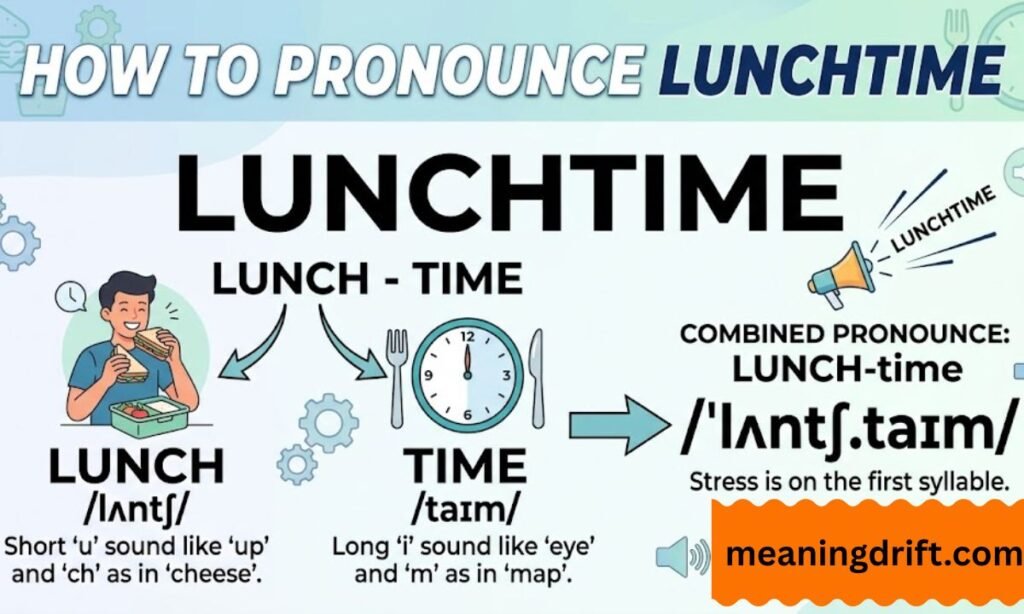
Lunchtime is pronounced /ˈlʌntʃ.taɪm/. The stress falls on the first syllable: Lunch Time.
- The lunch portion rhymes with bunch and crunch.
- The time portion sounds like the standalone word time /taɪm/.
There is no difference in pronunciation between lunchtime and lunch time they sound identical in everyday speech. The distinction only appears in written English.
Lunch Time Hours in the USA

In the United States, lunchtime is most commonly observed between 12:00 PM and 1:00 PM, though this varies by region, industry, and personal schedule.
Standard U.S. Lunchtime Windows:
| Setting | Typical Lunchtime Hours |
| Office workers | 12:00 PM – 1:00 PM |
| School children (elementary) | 11:00 AM – 1:00 PM |
| Middle/high school | 10:30 AM – 2:00 PM |
| Shift workers / early risers | 11:00 AM – 12:00 PM |
| Flexible/remote workers | Varies |
The average lunch break in American workplaces ranges from 30 minutes to one hour. In some flexible environments, employees choose their own lunchtime within a set window. In traditional corporate settings, the noon hour remains the standard. On hectic days, many Americans eat at their desks while continuing to work.
Regional differences also exist. East Coast workers in busy cities like New York typically take lunch from 12:00 PM to 1:00 PM. Midwesterners often follow similar patterns, while Southern states like Texas and Florida may extend lunchtime slightly, reflecting a culture that values hospitality and social meals.
Breakfast, Lunch, and Dinner Time
Mealtime terminology follows consistent patterns in English though not always identical rules.
| Meal | One Word | Two Words | Notes |
| Breakfast | Breakfasttime (rare) | Breakfast time | Breakfast alone usually suffices |
| Lunch | Lunchtime ✅ | Lunch time (less preferred) | Compound noun is standard |
| Dinner | Dinnertime ✅ | Dinner time (acceptable) | Both widely used |
| Supper | Suppertime ✅ | Supper time (informal) | Compound preferred |
| Tea | Tea time / Teatime | Both used | British English context |
The key takeaway: lunchtime, dinnertime, and suppertime all follow the compound noun rule. Breakfast is the exception it typically stands alone rather than merging with time in everyday usage.
Lunchtime vs Lunch Time Grammar in Practice
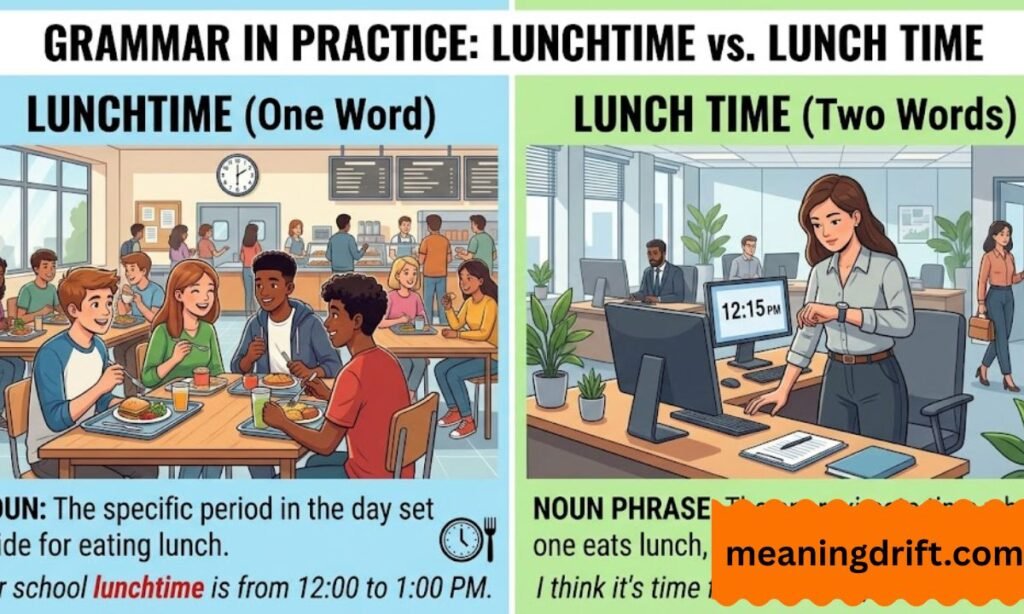
Both forms appear in published English, but they serve slightly different communicative purposes.
Use lunchtime when:
- Referring to the general period of the day (casual or professional writing)
- Writing articles, emails, or social content
- Following modern style guides and dictionaries
Example: “We’ll review the proposal during lunchtime.”
Use lunch time when:
- Emphasizing a specific scheduled time slot
- Writing formal timetables or official documents
- Distinguishing the time from the meal itself
Example: “The lunch time for the conference has been set at 12:30 PM.”
Avoid: lunchTime (camel case incorrect in English), lunch-time (hyphenated archaic and outdated), or switching between both forms within the same document.
Lunchtime vs Lunch Time – Key Differences
At a glance, here is the clearest summary of how these two forms differ:
| Feature | Lunchtime | Lunch Time |
| Spelling | One word | Two words |
| Grammar type | Compound noun | Noun phrase |
| Dictionary status | Standard (Merriam-Webster, Cambridge, Oxford) | Not listed as a standalone entry |
| Formality | Suitable for all contexts | Best for scheduling/timetables |
| Frequency of use | Much more common | Less common |
| Modern preference | ✅ Preferred | Used selectively |
The bottom line: lunchtime is the modern standard. Lunch time is not incorrect, but it reads as slightly dated or overly formal outside of scheduling contexts.
Comparison With Other Mealtime Expressions
Lunchtime is part of a broader family of mealtime compound words in English:
- Dinnertime the evening meal period; widely used in both American and British English
- Suppertime often used in older or Southern American English for the evening meal
- Teatime a British tradition referring to the late afternoon snack break, usually around 3:00–5:00 PM
- Brunch a portmanteau of breakfast and lunch, used for late-morning meals (typically 10:00 AM–12:00 PM)
- Mealtime a general term for any scheduled eating period
Interestingly, many other languages reflect similar compound logic. In German, Mittagessen literally translates to “midday meal” a concept nearly identical to lunchtime in English.
Also Read This:ISTG Meaning in Text Complete Breakdown 2026
Historical Usage of Lunchtime
The concept of a structured midday meal is centuries old, but the word lunchtime as we know it today is a product of the industrial era.
- Pre-19th century: Most people ate two meals a morning breakfast and a larger evening dinner. A small midday snack, called a luncheon, existed but was informal.
- 1800s: Factory workers in England began receiving formal midday breaks, and newspapers started referencing lunchtime as a recognized daily event.
- 1859: The first recorded use of lunchtime appears in print, per Merriam-Webster.
- Early 1900s: School schedules began including official lunch periods for children.
- Post-World War II: Corporate offices standardized the lunch hour typically a one-hour break as part of the 9-to-5 workday.
This historical arc mirrors the evolution of similar compound words across English. As lunch became a daily ritual, its associated vocabulary consolidated and standardized.
Lunchtime in Modern Context
Today, lunchtime is universal but what it looks like varies enormously depending on culture, technology, and work style.
In the modern workplace, remote work has shifted lunchtime habits significantly. Employees working from home often eat at irregular hours, blurring the traditional noon-hour break. In contrast, hybrid office workers tend to maintain more structured lunchtime routines.
Social media has also turned lunchtime into a cultural moment “lunchtime posts,” food photography, and midday wellness content have made the noon hour a content category of its own.
Workplace and School Lunchtime Practices
In the workplace:
- Corporate offices typically offer 30–60 minute breaks between 12:00 PM and 1:00 PM
- Some employees eat at their desks to save time; others use lunchtime to socialize or recharge
- Team lunch meetings have become a common productivity tool
- Flexible and freelance workers often define their own lunchtime schedules
In schools:
- Elementary schools in the U.S. schedule lunch between 11:00 AM and 1:00 PM
- Middle and high schools may stagger lunch periods to manage cafeteria capacity
- School lunch programs provide nutritional meals to millions of students daily
- Lunchtime at school serves a dual purpose: nutrition and social development
Cultural Variations of Lunchtime
Lunchtime is not a one-size-fits-all concept. Around the world, midday meal customs vary dramatically:
| Country | Typical Lunchtime | Cultural Notes |
| United States | 12:00 PM – 1:00 PM | Quick meals; often eaten at desks |
| United Kingdom | 12:30 PM – 1:30 PM | Called “dinner hour” in Northern England |
| Spain | 2:00 PM – 3:00 PM | Longest meal of the day; siesta follows |
| Italy | 1:00 PM – 2:00 PM | Leisurely, social, multi-course |
| France | 12:30 PM – 2:00 PM | Lunch is culturally protected time |
| Japan | 12:00 PM – 1:00 PM | Often a bento box; efficient and brief |
| Australia | 12:00 PM | Light meal; called “lunch” universally |
In Spain, shifting school lunchtime earlier has reportedly disrupted traditional family meal patterns illustrating how deeply lunchtime is tied to culture, not just the clock.
Lunchtime Etiquette and Social Norms
Lunchtime behavior is shaped by both setting and culture. Here are widely accepted norms:
In the workplace:
- Avoid strong-smelling foods in shared spaces
- Keep conversations professional when dining with colleagues
- Respect others’ break time not everyone wants to talk shop over lunch
In social or formal settings:
- Wait for everyone to be served before eating
- Follow the host’s lead for when the meal begins and ends
- Silence or lower the volume on your phone
In schools:
- Students are expected to stay in designated lunch areas
- Sharing food is common but may be restricted due to allergy policies
The broader principle: lunchtime is a shared ritual. Respecting others’ time, space, and food preferences makes it a pleasant experience for everyone.
Common Misconceptions About Lunchtime
Myth 1: “Lunch Time” is informal and incorrect in formal writing. Truth: It is accepted in both formal and informal contexts by all major dictionaries and style guides.
Myth 2: “Lunch time” is always grammatically wrong. Truth: It is correct just less standard. It works best when emphasizing a specific scheduled time.
Myth 3: Lunchtime always means exactly 12:00 PM. Truth: Lunchtime is a flexible window, typically between 11:00 AM and 2:00 PM, depending on culture and routine.
Myth 4: Lunchtime etiquette is the same everywhere. Truth: Social norms vary significantly by country, workplace, and cultural background.
Myth 5: The hyphenated form “lunch-time” is still acceptable. Truth: The hyphenated form is a historical relic. Modern English has standardized the one-word compound lunchtime.
Frequently Asked Questions
Is lunchtime one word or two?
Lunchtime (one word) is the correct and standard modern form recognized by all major dictionaries.
Can I use “lunch time” instead of “lunchtime”?
Yes, but it is less common and best reserved for contexts where you are emphasizing a specific scheduled time.
Is “lunch-time” with a hyphen correct?
No this is an outdated form. Modern usage favors the closed compound lunchtime.
Is lunchtime the same across all cultures?
No. Countries like Spain eat lunch around 2:00 PM, while Japan and the U.S. typically eat closer to noon.
What is the difference between lunchtime and dinnertime?
Both are compound nouns referring to meal periods. Lunchtime refers to the midday meal; dinnertime refers to the evening meal.
Conclusion
The debate between lunchtime vs lunch time has a clear winner in modern English: lunchtime (one word) is the preferred, dictionary-recognized standard. That said, lunch time is not wrong it simply serves a more specific purpose when scheduling or emphasizing exact timing. Beyond the grammar, lunchtime is a rich daily ritual shaped by history, culture, workplace norms, and social customs. Whether you’re grabbing a sandwich at your desk in New York or sitting down to a multi-course meal in Madrid, lunchtime is far more than a break it’s a moment of connection, culture, and routine that defines the rhythm of the day.

Thomas is the creator of MeaningDrift, a writer guided by curiosity and a passion for meaning. With a background in existential psychology and comparative spirituality, Thomos translates deep questions into clear, compassionate guidance. Their writing invites readers to explore life’s purpose and craft meaning in everyday moments.