

Have you ever paused mid-sentence, unsure whether to write “I run to the store yesterday” or “I ran to the store yesterday”? You are not alone. The debate between run vs ran trips up learners and even native speakers regularly.
These two words share the same root verb yet serve entirely different grammatical roles. Get them right and your writing sounds polished. Get them wrong and the sentence breaks. This guide covers grammar rules, pronunciation, idioms, conjugation, and common mistakes to make run vs ran second nature.
Why Understanding ‘Run’ vs. ‘Ran’ Matters
Verb tense is not decoration it is meaning. When you choose between run and ran, you signal when something happened. A sentence like “She run the company for ten years” sounds immediately off, because these two forms carry distinct time signals the reader processes automatically. For learners, getting this right builds credibility. For professionals, it prevents errors in reports, emails, and presentations. Knowing when to use run vs ran makes your English accurate, natural, and trusted.
Also Read This:Snowball Kiss Meaning: What It Really Means and Why People Do It
The Basics: What Are ‘Run’ and ‘Ran’?
Both words are forms of the same irregular verb to run. Here is what sets them apart:
- Run the base form (infinitive) and the past participle. Used for present tense, habitual actions, and perfect tenses with helping verbs.
- Ran the simple past tense form exclusively. Used only for completed actions in the past without any helping verb.
| Form | Type | Example |
| Run | Base / Present | I run every morning. |
| Runs | Present (3rd person) | She runs every morning. |
| Ran | Simple Past | I ran yesterday. |
| Run | Past Participle | I have run five miles. |
| Running | Present Participle | I am running right now. |
One clean rule: if you can insert “yesterday,” use ran. If you can insert “every day,” use run.
Using ‘Run’ in the Present Tense
When you use run in the present tense, it describes a habit, a fact, or an action happening now. It also pairs with helping verbs (have, has, had) in perfect tenses.
- I run three miles before breakfast.
- She runs the regional office.
- This software runs on all major systems.
Note the third-person rule: with he, she, or it, always add -s she runs, he runs, it runs.
I Have Run or Ran the Report?

This is one of the most searched grammar questions. The answer is non-negotiable: “I have run the report” is always correct. “I have ran the report” is always wrong. Helping verbs (have, has, had) require the past participle and the past participle of run is run, never ran.
| Incorrect | Correct |
| I have ran the report. | I have run the report. |
| She has ran five miles. | She has run five miles. |
| They had ran out of time. | They had run out of time. |
A quick mental trigger: see have, think run.
Run vs Ran Pronunciation
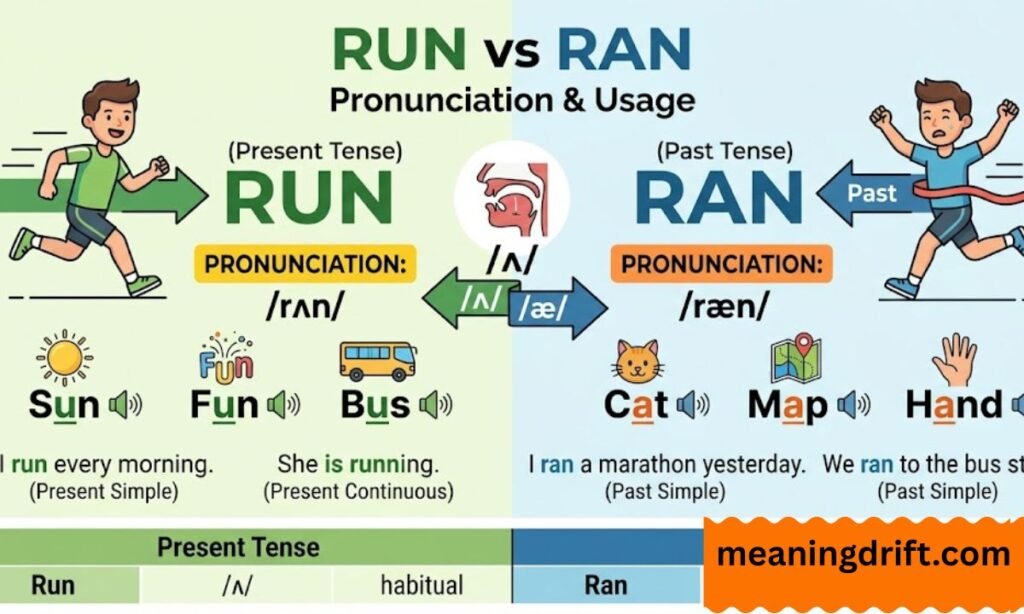
- Run short “uh” vowel sound: /rʌn/ (rhymes with “fun”)
- Ran short “a” vowel sound: /ræn/ (rhymes with “can”)
The vowel is the only thing that changes. In careful speech and formal writing, the distinction is always maintained.
Run vs Ran Grammar
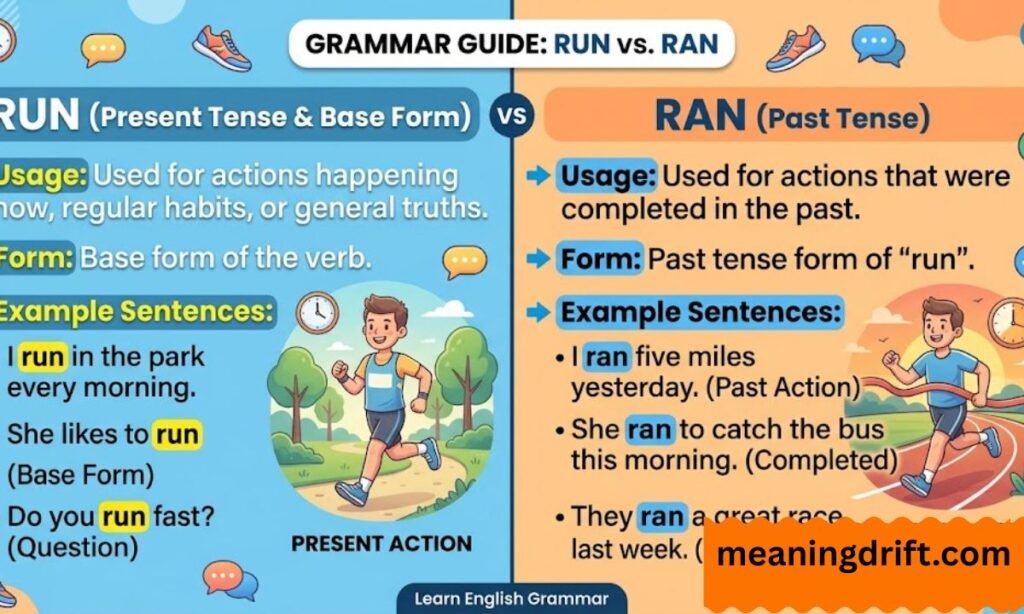
The grammar rule in one sentence: Use run for present and perfect tenses; use ran for simple past only. Ran never appears after a helping verb. Run never appears as a standalone simple past verb. That two-way boundary eliminates nearly every common error.
Common Phrases and Idioms Featuring ‘Run’
English idioms overwhelmingly prefer run in its base form. Only the conjugation changes when you shift tense.
| Idiom | Meaning | Past Example |
| Run out of | Deplete or exhaust | We ran out of milk. |
| Run the show | Be in charge | She runs the show. |
| Run errands | Complete tasks | I ran errands all afternoon. |
| Run into someone | Meet unexpectedly | I ran into an old friend. |
| Run the risk | Face a possibility | We run the risk of being late. |
When to Use Run vs Ran
- Helping verb (have / has / had) present? → Use run
- Action finished in the past, no helping verb? → Use ran
- Present, habitual, or ongoing action? → Use run
The Past Tense: Using ‘Ran’ Correctly
Ran is the simple past tense of run. It stands alone no helping verb needed or allowed.
- She ran the Boston Marathon last spring.
- The program ran without errors during testing.
- He ran toward the exit the moment the alarm sounded.
The action must be completed, set in the past, and free of any auxiliary verb. If any of those conditions fails, return to run.
Past Continuous: Adding Context
The past continuous describes an action in progress at a specific past moment. For run, use was/were + running not ran.
- At 6 AM, I was running along the river path.
- They were running tests when the system crashed.
Past continuous emphasizes ongoing activity; simple past (ran) reports a completed fact. Use the continuous form when you want to paint a scene rather than state a single event.
Conjugating ‘Run’ Across All Tenses
| Tense | Example |
| Simple Present | I run. She runs. |
| Present Continuous | I am running. |
| Present Perfect | She has run. |
| Simple Past | I ran. |
| Past Continuous | I was running. |
| Past Perfect | She had run. |
| Simple Future | I will run. |
| Future Perfect | I will have run. |
The pattern is clear: ran appears only once in simple past. Every other tense uses run or running.
Common Misconceptions About ‘Run’ and ‘Ran’
“Have ran sounds more formal.” Wrong it is always grammatically incorrect, regardless of formality.
“I run yesterday is fine in casual speech.” Wrong past time markers (yesterday, last week) always demand ran.
“Ran can serve as a past participle.” Never. “He has ran the race” is incorrect in all forms of standard English. “He has run the race” is always correct.
Irregularities and Exceptions
Run is irregular because it does not add -ed to form its past tense. It traces to Old English rinnan, where strong verbs changed internal vowels to signal tense a pattern shared by sing → sang, swim → swam, and come → came.
| Verb | Past Tense | Past Participle |
| Walk (regular) | Walked | Walked |
| Run (irregular) | Ran | Run |
There are no regional exceptions. British and American English treat run and ran identically.
Practical Examples: ‘Run’ vs. ‘Ran’ in Context
| Context | Present (run) | Past (ran) | Perfect (have run) |
| Sports | I run daily. | I ran yesterday. | I have run 100 races. |
| Business | She runs the team. | She ran the project. | We have run this for years. |
| Technology | It runs smoothly. | It ran overnight. | It has run without errors. |
Common error corrections:
| Incorrect | Correct | Reason |
| Yesterday I run to school. | Yesterday I ran to school. | Past time marker needs ran |
| I have ran this report. | I have run this report. | Helping verb needs run |
| She will ran tomorrow. | She will run tomorrow. | Future uses base form |
Why Tense Accuracy Matters
Tense mistakes do not just break rules they blur timelines and undermine credibility. “The system has ran for three hours” sounds unpolished. “The system has run for three hours” is clean and professional. In storytelling, consistent past tense (ran) keeps the narrative timeline seamless and the reader oriented
Quick Reference Guide for Learners
| Situation | Correct Form | Example |
| Present habit | run / runs | She runs daily. |
| Action right now | am/is/are running | I am running. |
| Completed past | ran | I ran yesterday. |
| After have / has / had | run | I have run. |
| Future action | will run | He will run. |
| Ongoing past action | was/were running | They were running. |
Golden rule: Helping verb present → always run. Action finished in the past → always ran.
Conclusion
Mastering run vs ran comes down to one principle: time and helping verbs determine the form. Use run for present actions, habits, and any tense paired with have, has, or had. Use ran for completed past actions with no auxiliary verb. The most persistent error “I have ran” disappears the moment you link helping verbs permanently to the past participle run. Practice writing sentences in both tenses, read authentic English regularly, and pay attention to the verb forms used around you. With consistent exposure, choosing between run and ran becomes automatic, and your writing gains the clarity and authority that precise grammar always delivers.
Frequently Asked Questions
Is it “I have run” or “I have ran”?
Always “I have run.” Helping verbs require the past participle run, never ran.
When do I use “ran” instead of “run”?
Use ran for a completed past action without a helping verb: “She ran five miles yesterday.”
Is “run” an irregular verb?
Yes. Its past tense is ran and its past participle is run no -ed ending involved.
Do British and American English differ on run vs ran?
No. The rules are identical in both dialects.
Can “ran” appear in future tense sentences?
Never. Future sentences use “will run” or “will be running.”
Why is “I have ran” always wrong?
Because ran is simple past only and cannot serve as a past participle. “I have run” is the only correct form.

Thomas is the creator of MeaningDrift, a writer guided by curiosity and a passion for meaning. With a background in existential psychology and comparative spirituality, Thomos translates deep questions into clear, compassionate guidance. Their writing invites readers to explore life’s purpose and craft meaning in everyday moments.