

“Diabolical” is an adjective rooted in ancient Greek and Latin that primarily means extremely evil, wicked, or characteristic of the devil. In modern everyday English and online chat, it has also taken on a looser slang sense used humorously to describe something outrageously bad, cleverly mischievous, or wildly over the top. Depending on tone and context, the same word can be dead serious or laugh-out-loud funny.
What Does Diabolical Mean?
At its most basic, diabolical means of or relating to the devil; extremely evil or cruel. It is an adjective, and a strong one at that. When you call something diabolical, you are saying it goes beyond ordinary badness into something deeply wicked, sinister, or morally corrupt.
Part of speech: Adjective Pronunciation: /ˌdaɪ.əˈbɒl.ɪ.kəl/ Adverb form: Diabolically
Think of it this way: if “bad” is a frown, and “terrible” is a gasp, then “diabolical” is a full horror-movie scream.
Diabolical Meaning in Everyday English
In plain everyday language, people use diabolical to describe:
- A villain’s cunning and cruel master plan
- Behavior that is shockingly immoral or manipulative
- Something of extremely poor quality (especially in British English)
- A situation that feels almost wickedly unfair
“The conditions at that factory were diabolical.” “He came up with a diabolical scheme to cheat his way to the top.”
Diabolical Meaning in Slang
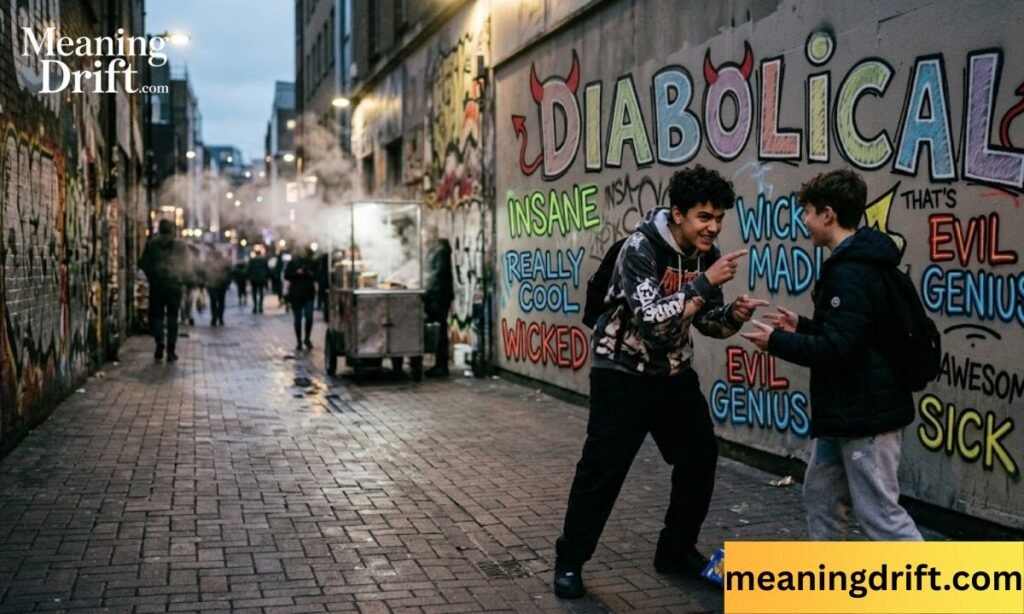
In casual conversation and texting, “diabolical” has drifted from its serious roots. In slang, it often means:
- Something hilariously bad “That haircut is diabolical, mate.”
- A clever but cheeky move “Ate the last slice of pizza and blamed the dog. Diabolical.”
- Something outrageously dramatic used for comic exaggeration
The slang version keeps the intensity of the original word but strips away the moral weight. It is hyperbole a dramatic way of reacting to everyday situations.
Diabolical Meaning in Chat
When someone uses “diabolical” in a text message or online chat, they are almost always going for one of two effects:
- Genuine criticism “That exam was diabolical. I failed every section.”
- Playful exaggeration “You ate my leftovers?? That’s diabolical 😤”
Reading the tone especially through emojis, punctuation, and context is the key to understanding which meaning is intended.
Origin and History of the Word Diabolical
Where Did Diabolical Come From?
The word traces back to the Greek word diabolos, which literally means “slanderer” or “one who throws accusations.” From there it moved into Latin as diabolus and then into Late Latin as diabolicus, before finally arriving in English around the early 1500s.
| Language | Word | Meaning |
| Ancient Greek | diabolos | Slanderer, accuser |
| Latin | diabolus | Devil |
| Late Latin | diabolicus | Of the devil |
| Old French | diabolique | Devilish |
| English (1500s) | diabolical | Extremely evil |
Interestingly, diabolos is also where the Spanish word diablo (devil) comes from so if you have ever heard someone say “El Diablo,” you already know the root.
Also Read This:Hawk Tuah Meaning: The Truth Behind the Internet’s Most Viral Phrase
How the Meaning Changed Over Time
When “diabolical” first appeared in English writing, it was almost exclusively religious. Early texts used it to describe the literal influence of Satan or demonic forces. Over time especially from the 18th and 19th centuries onward it expanded into literary and everyday use to describe any person, plan, or action that was extraordinarily cruel or clever in a menacing way.
By the 20th century, British slang had adopted it to mean simply very bad or disgraceful. In the 21st century, internet culture and Gen Z humor pushed it further into ironic and comedic territory.
What Does the Word Diabolical Mean Through Time?
- 1500s–1700s: Strictly religious; linked to the devil and demonic evil
- 1800s–1900s: Expanded to describe human wickedness, cunning plots, villains
- Mid-1900s: British slang “disgraceful” or “shockingly bad”
- 2000s–present: Internet slang hyperbolic humor, memes, Gen Z speech
Diabolical Meaning in Modern Usage
Diabolical in Conversations
Today, “diabolical” pops up in everyday conversation far more than you might expect. Here are some real-life usage patterns:
Serious usage:
- “The conditions in that prison are diabolical.”
- “He revealed a diabolical plan to manipulate the entire election.”
Casual/humorous usage:
- “My alarm didn’t go off. Diabolical start to the day.”
- “She charged £5 for a biscuit. Absolutely diabolical.”
Diabolical Meaning in Social Media and Slang
On platforms like TikTok, Twitter/X, and Instagram, “diabolical” has become a go-to word for dramatic, funny reactions. It fits perfectly in meme culture because it sounds intense but can be applied to the most trivial situations making the gap between the word and the situation itself the joke.
Common social media uses:
- TikTok captions on relatable fail videos: “My sleep schedule is diabolical.”
- Twitter hot takes: “Whoever invented Mondays is diabolical for this.”
- Memes featuring cats or dogs with a “scheming” look captioned as “diabolical behavior.”
Diabolical Meaning Synonyms at a Glance
| Synonym | Tone |
| Fiendish | Serious implies cunning evil |
| Wicked | Serious or playful depending on context |
| Sinister | Serious dark and threatening |
| Devilish | Slightly playful or serious |
| Diabolical | Strong serious or ironic depending on use |
| Atrocious | Often used for quality (food, performance) |
| Hellish | Informal describes difficulty or discomfort |
How to Use Diabolical in a Sentence
Easy Sentence Examples
Here are natural, clear examples that show how to use “diabolical” correctly:
- The villain’s diabolical plot was finally uncovered by the detective.
- That traffic was absolutely diabolical I sat in it for two hours.
- She gave him a diabolical grin right before revealing she had won the bet.
- The working conditions at that plant were diabolical and completely unacceptable.
- He pulled a diabolical move by replying “K” to her three-paragraph message.
Formal vs Informal Usage
| Context | Example | Tone |
| Academic / formal writing | “The regime employed diabolical methods of suppression.” | Serious |
| News reporting | “Investigators uncovered a diabolical scheme to defraud investors.” | Serious |
| Everyday British English | “That curry was diabolical tasted like cardboard.” | Informal negative |
| Social media / texting | “My Wi-Fi went out during the finale. Diabolical.” | Humorous/exaggerated |
| Gen Z speech | “Bro set an 8 AM class? Diabolical for real.” | Ironic/playful |
Diabolical Meaning in the Bible
In biblical contexts, “diabolical” connects directly to the figure of Satan. The Greek diabolos appears in the New Testament to refer to the devil as an adversary and deceiver. Early Christian writers used the term to describe demonic influence, spiritual warfare, and the active opposition of evil forces against goodness. In this context, “diabolical” carries its full weight it is not metaphorical or humorous, but a description of genuine spiritual malice and cunning. The word signals not just wrongdoing, but a deliberate, scheming force of evil.
Synonyms and Opposite Words of Diabolical
Common Synonyms
These words share overlapping meaning with “diabolical,” though each has its own shade of intensity:
- Fiendish clever and cruel, like a fiend
- Sinister suggesting hidden, threatening evil
- Devilish resembling or worthy of the devil
- Satanic directly associated with Satan; very strong
- Wicked morally wrong; also used playfully (“wicked smart”)
- Malevolent having or showing a wish to do evil
- Nefarious criminal or wicked in a calculated way
- Vile extremely unpleasant or morally despicable
Antonyms of Diabolical
| Antonym | Meaning |
| Angelic | Pure, good, heavenly |
| Benevolent | Kind and generous |
| Moral | Having good values |
| Virtuous | Morally excellent |
| Holy | Sacred, spiritually pure |
| Saintly | Exceptionally good or pure |
Diabolical Meaning Gen Z Perspective
For Gen Z, “diabolical” is less about Satan and more about savage behavior that earns a grudging respect. It sits alongside words like “devious,” “unhinged,” and “wild” in their vocabulary. When a Gen Z person calls something diabolical, there is often a hint of admiration mixed in like watching someone make a bold, chaotic move and saying “that was diabolical, but respect.”
Common Gen Z uses:
- Describing a friend who texts back three days late: “The audacity is diabolical.”
- Reacting to an unexpected plot twist: “The writers are diabolical for this ending.”
- Calling out bad food: “This vending machine sandwich is diabolical.”
Is Diabolical Always a Negative Word?
Serious Meaning vs Funny Usage
No and that is what makes “diabolical” so interesting. Its tone depends entirely on context.
When it is negative and serious: The word lands hard when used to describe real cruelty, injustice, or suffering. In journalism, history, and formal speech, calling something diabolical is a strong condemnation.
When it is funny and ironic: Online and in casual speech, the same word becomes a punchline. Applying a word that once meant “satanic evil” to burnt toast or a bad Wi-Fi connection creates instant comic effect.
When People Use It as a Joke
The humor in calling something “diabolical” comes from the mismatch the word is way too big for the situation. This technique is called hyperbole, and English speakers love it:
- “The printer jammed again. Diabolical machine.”
- “They moved up the meeting to 7 AM. Truly diabolical.”
- “She didn’t save any pizza for me. That’s diabolical behavior.”
Diabolical Meaning in Different Contexts
Diabolical Character Meaning
When a character in a film, book, or TV show is described as diabolical, it means they are cunning, cruel, and genuinely threatening. Think of the classic movie villain who does not just commit crimes they scheme, they manipulate, they enjoy the wickedness of it. A diabolical character is intelligent in their evil, not just randomly violent.
Examples in fiction: Hannibal Lecter, Iago from Othello, or any Bond villain with a plan for world domination.
Diabolical Plan Meaning
A “diabolical plan” is not just a bad plan it is a brilliantly conceived but deeply immoral one. It implies the planner is clever, calculated, and willing to cross ethical lines to succeed. The phrase is used both seriously (to describe real-world manipulation or fraud) and humorously (to describe something mischievous like surprising a friend with a prank).
Frequently Asked Questions About Diabolical Meaning
Does diabolical mean evil?
Yes, at its core but in casual slang, it can simply mean outrageously bad, clever, or absurd without implying true moral evil.
What does diabolical mean in slang?
In slang, it describes something wildly bad, savage, or cleverly mischievous often with a tone of exaggerated shock or dark humor.
Is diabolical a strong word?
Yes, very. It is stronger than “terrible” or “awful” and implies a deep, calculated kind of wrongness.
Can diabolical be used as a compliment?
Rarely in formal settings, but in Gen Z and internet slang, it can carry a grudging admiration especially for bold or unexpected moves.
What is the difference between diabolical and diabolic?
They mean the same thing. “Diabolic” is slightly older and less common; “diabolical” is the more widely used modern form.
What does diabolical mean in British slang?
In British English, it informally means disgracefully bad often applied to food, weather, performances, or service quality.
What does “that’s diabolical” mean in a text?
Depending on tone, it either means “that is genuinely terrible” or more often in casual texting “wow, that is outrageously bad/cheeky/funny.”
Conclusion
The word “diabolical” has traveled a long road from ancient Greek courtrooms where diabolos described an accuser, through religious texts warning of Satan’s influence, to British tea rooms complaining about terrible scones, and finally to TikTok comment sections reacting to the most relatable life disasters.
What makes it so enduring is its flexibility. Few words can convey genuine moral horror in one sentence and land as a dry punchline in the next. Whether you are writing a serious essay, texting a friend, crafting a story, or just reacting to your Monday morning commute “diabolical” delivers exactly the dramatic energy you need.
Now that you know the full picture, you can use it with confidence and honestly, knowing when to drop “diabolical” in a conversation is, well… a little diabolical in itself.

Thomas is the creator of MeaningDrift, a writer guided by curiosity and a passion for meaning. With a background in existential psychology and comparative spirituality, Thomos translates deep questions into clear, compassionate guidance. Their writing invites readers to explore life’s purpose and craft meaning in everyday moments.