
A caveat is a warning or condition attached to a statement, agreement, or action most commonly used to highlight limitations or exceptions.
In academic and legal settings, it signals that something must be considered before proceeding. You may also encounter it in everyday conversation as a polite way to flag an important “but.”
What Does Caveat Mean?
At its most basic, a caveat is a warning. It tells you or someone else to slow down and take note of something important before moving forward.
When someone says, “I’ll support your plan, with one caveat,” they mean: “I agree, but there’s something you need to keep in mind.” It’s not a full stop it’s a speed bump.
The word is pronounced KAV-ee-at (three syllables). Some people also say KAY-vee-at, and both are widely accepted in formal speech.
Caveat Meaning Explained in Simple Words
In plain English, a caveat is a condition, qualification, or warning added to an idea, statement, or agreement. Think of it as the fine print of a conversation.
It often appears in situations like:
- A doctor explains a treatment plan, then adds a caveat about side effects
- A business deal is agreed upon, with a caveat about payment terms
- A researcher shares data, noting a caveat about sample size limitations
The key takeaway: a caveat doesn’t cancel what was said it adds important context to it.
Origin and History of the Word Caveat
The word caveat comes directly from Latin, where it means “let him beware.” It is the third-person singular present subjunctive of the Latin verb cavēre, meaning “to be on guard” or “to take care.”
This same Latin root also gave English the word caution both share the idea of careful awareness.
Caveat first entered the English language in legal contexts around the 1530s–1540s, used as a formal notice in court proceedings. Over time, it moved beyond the courtroom into everyday speech, business language, science, and medicine becoming the versatile word we use today.
How to Pronounce Caveat Correctly
| Pronunciation | Accepted? | Common In |
| KAV-ee-at | ✅ Yes | Most common, widely accepted |
| KAY-vee-at | ✅ Yes | Also acceptable |
| KAV-ee-at (3 syllables) | ✅ Yes | Standard across all regions |
The word has three syllables. A common mistake is saying it as two syllables (“CAV-at”). Take your time and enunciate each part: CAV – ee – at.
Caveat Meaning in Law
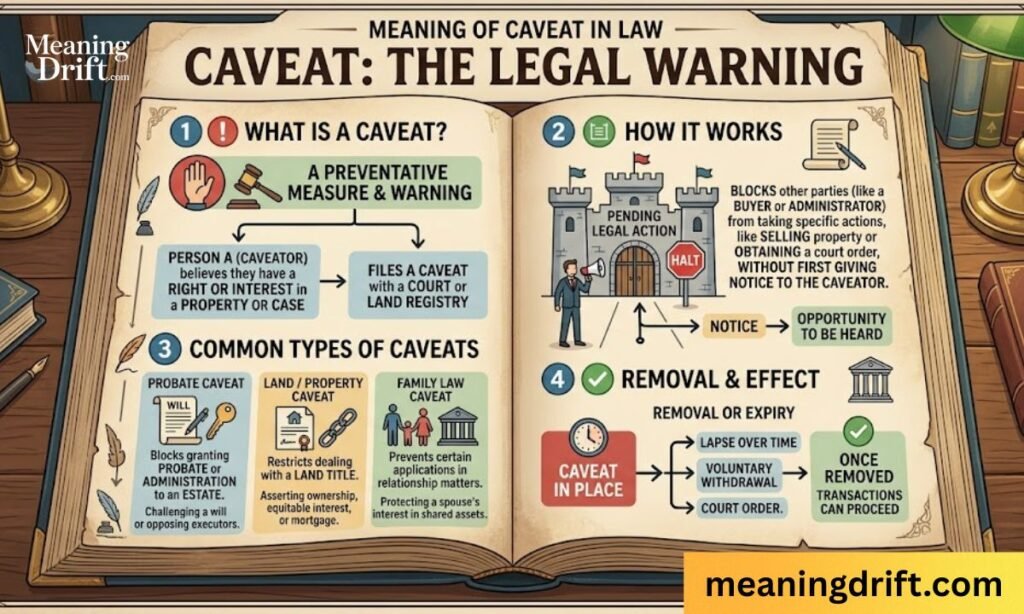
In legal terminology, a caveat is a formal written notice filed with a court or public authority, requesting that a specific action be suspended until the filing party has been heard.
Common legal uses include:
- Probate law: Filing a caveat to stop the proving of a will when its validity is disputed
- Property law: Placing a caveat on land to protect an unregistered interest or claim
- Patent law: Historically used to notify patent offices not to grant a patent without informing the filer
- Family law: Used in proceedings to protect a party’s rights during a dispute
Example: “The deceased’s daughter filed a caveat to prevent probate of the will, claiming it was signed under duress.”
In Australian property law and other Torrens title systems, a caveat specifically warns that someone other than the registered owner claims an interest in the property.
Also Read This:Diabolical Meaning in Text: Complete Guide with Definition and Examples
Caveat Meaning in Different Contexts
The word caveat appears across multiple fields, and its meaning shifts slightly depending on the context.
Caveat Meaning in Business
In business, a caveat is a qualifying condition or limitation added to a proposal, contract, or offer. It protects one party by flagging conditions that must be met or risks that must be acknowledged.
Example: “We’re happy to proceed with the partnership, with the caveat that delivery timelines must be confirmed in writing.”
Business caveats often appear in:
- Contract negotiations
- Investment proposals
- Financial disclosures
- Client presentations
Caveat Meaning in Statistics
In research and data analysis, a caveat refers to a limitation or condition that affects how results should be interpreted. Researchers use caveats to maintain honesty and scientific integrity.
Example: “The study shows a strong correlation between the two variables with the caveat that the sample size was limited to 150 participants.”
Statistical caveats may relate to sample bias, data collection methods, or limitations in the study design.
Caveat Meaning in Medicine
In healthcare, a medical caveat is a warning or precautionary note added by a physician or researcher about the risks, limitations, or conditions associated with a treatment, diagnosis, or finding.
Example: “The new drug shows promising results, with the caveat that long-term effects have not yet been studied.”
Medical caveats are critical for informed consent and patient safety.
How to Use Caveat in a Sentence
Here are clear, practical examples of caveat used in real sentences:
- “She agreed to lend him the car, with the caveat that he return it with a full tank.”
- “The financial advisor recommended the investment, but added an important caveat about market volatility.”
- “The teacher gave the student a caveat one more disruption and he would be sent to the principal.”
- “I’ll support this proposal, with one caveat: the budget must be approved first.”
- “The lawyer entered a caveat to delay the court proceedings.”
Real-Life Examples of Caveat
| Situation | How Caveat Is Used |
| Job offer | “You got the job, with the caveat that training must be completed in 30 days.” |
| Medical advice | “You can return to exercise, with the caveat that you avoid high-impact activity.” |
| Research paper | “Results were positive, with the caveat that further testing is needed.” |
| Property deal | “A caveat was placed on the land title to protect the buyer’s interest.” |
| Business contract | “The deal was signed, with the caveat that terms could be revised quarterly.” |
Common Phrases That Include Caveat
Several well-known phrases are built around the word caveat:
- “With the caveat that…” The most common structure; introduces a condition or limitation
- “Add a caveat” To include a qualifying note or warning
- “One caveat…” Signals a single important condition
- “Enter a caveat” Formal legal usage; filing a notice with a court
- “The usual caveats apply” Standard disclaimer in business and media contexts
What Does Caveat Emptor Mean?
Caveat Emptor is a Latin legal phrase meaning “Let the buyer beware.”
Caveat Emptor Meaning Explained
<cite index=”11-1″>It is a principle in contract law, particularly controlling the sale of real property, that places the responsibility of due diligence on the buyer.</cite> The idea is simple: before you buy something, you are responsible for checking its condition and quality. If something turns out to be defective after purchase, you generally cannot blame the seller you had the chance to inspect it.
<cite index=”11-1″>This principle emerged largely because buyers often have less information than sellers about a good or service a situation economists call “information asymmetry.”</cite>
Modern relevance: While consumer protection laws have significantly reduced the scope of caveat emptor in retail transactions, it still applies in many business-to-business deals and private property sales.
Example: “The car was sold as-is. Caveat emptor the buyer should have inspected the engine before signing.”
Meaning of Caveator
A caveator is the person who files or lodges a caveat typically in a legal proceeding. In property and probate law, the caveator is the individual who formally notifies a court or authority to pause proceedings until their claim or concern is addressed.
Example: “As the caveator, she had the right to be heard before the will was admitted to probate.”
Caveat vs Warning – What Is the Difference?
Many people use caveat and warning interchangeably, but there are subtle differences worth knowing.
| Feature | Caveat | Warning |
| Tone | Formal, qualified | Direct, urgent |
| Context | Law, business, academia | Everyday speech, safety |
| Function | Adds a condition or limitation | Alerts to danger or consequence |
| Formality | High | Low to high |
| Example | “With the caveat that…” | “Warning: Do not touch.” |
Key distinction: A warning often signals immediate danger or consequences, while a caveat is more of a nuanced qualifier a “however” or “but keep this in mind” attached to a larger statement.
Synonyms and Antonyms of Caveat
Synonyms (Words with Similar Meaning)
- Warning
- Caution
- Qualification
- Condition
- Proviso
- Stipulation
- Admonition
- Disclaimer
- Reservation
- Restriction
Antonyms (Opposite Meaning)
- Guarantee
- Assurance
- Endorsement
- Approval
- Authorization
- Confirmation
- Clearance
Common Mistakes When Using Caveat
Even educated writers occasionally misuse this word. Here are the most frequent errors to avoid:
- Mispronouncing it Saying “CAV-at” (two syllables) instead of “KAV-ee-at” (three)
- Using it as a synonym for “problem” A caveat isn’t a flaw; it’s a condition or qualification
- Overusing it Not every disclaimer needs to be called a caveat; sometimes “note” or “condition” is clearer
- Plural confusion The correct plural is caveats, not “caveata” (a common Latinism error)
- Confusing it with “warning” A warning suggests danger; a caveat suggests a limitation or exception
Is Caveat a Positive or Negative Word?
Caveat sits in neutral territory it is neither inherently positive nor negative.
Its emotional weight depends entirely on context:
- In a contract negotiation, a caveat can be protective and constructive it safeguards both parties
- In casual speech, it can feel slightly negative if it comes after good news (“You got the job with one caveat…”)
- In research, it is seen as a sign of integrity honest scientists always acknowledge caveats
Think of it this way: a caveat is a responsible qualification. Used well, it reflects expertise and transparency.
Frequently Asked Questions About Caveat Meaning
What is the simplest definition of caveat?
A caveat is a warning or condition a “but” that adds important context to a statement or agreement.
How do you pronounce caveat?
It is pronounced KAV-ee-at, with three syllables.
Is caveat a formal word?
Yes, it leans formal. It is common in legal, academic, and business writing, though it also appears in everyday speech.
What does “with the caveat that” mean?
It introduces a condition or limitation essentially saying “this is true, but keep this important thing in mind.”
What is the plural of caveat?
The correct plural is caveats.
What does caveat emptor mean in simple terms?
It means “let the buyer beware” the buyer takes responsibility for checking a product before purchasing.
What is a caveator?
A caveator is the person who files a caveat, typically in a legal or property proceeding.
Can caveat be used as a verb?
Informally, yes people sometimes say “she caveated her statement,” though this usage is still uncommon in formal writing.
Is caveat used in everyday conversation?
It is more common in professional and academic contexts, but it does appear in everyday speech, especially when someone wants to add a nuanced condition to what they are saying.
What is the difference between a caveat and a disclaimer?
A disclaimer typically removes legal responsibility, while a caveat adds a qualifying condition or limitation. Both serve to clarify, but their legal weight differs.
Final Thoughts on Caveat Meaning
Caveat is one of those words that sounds complex but is actually quite useful once you understand it. Whether you encounter it in a legal document, a research paper, a business proposal, or casual conversation, the core meaning remains consistent: pay attention to this condition before you move forward.
From its Latin roots meaning “let him beware” to its modern role across law, medicine, business, and statistics, caveat has proven to be a remarkably durable word. Knowing when and how to use it and understanding related terms like caveat emptor and caveator gives you a sharper command of both formal English and professional communication.
Next time someone says “I love the idea with one caveat,” you will know exactly what is coming: an important condition that deserves your full attention.

Thomas is the creator of MeaningDrift, a writer guided by curiosity and a passion for meaning. With a background in existential psychology and comparative spirituality, Thomos translates deep questions into clear, compassionate guidance. Their writing invites readers to explore life’s purpose and craft meaning in everyday moments.