

You’re scrolling through a group chat, reading a work email, or watching a TikTok caption and you hit those three letters: TBC. Simple enough, right? Not quite. Depending on where you saw it, TBC could mean something completely different.
That’s what makes it one of the most misread abbreviations in digital communication. It floats between casual texting, corporate schedules, film credits, automotive fuse boxes, and even medical reports each time carrying a slightly different weight.
This guide breaks down every meaning of TBC, across every context, so you never misread it again.
What Does TBC Mean?
TBC stands for “To Be Confirmed” or “To Be Continued,” depending on how and where it’s used.
- To Be Confirmed A placeholder used when details exist but aren’t finalized yet. It signals that an official update is coming.
- To Be Continued A storytelling device used when a conversation, video, or episode hasn’t reached its end.
Both meanings share a common thread: something is incomplete, and more is on the way. Unlike vague phrases like “maybe” or “I’ll let you know,” TBC is a structured signal precise, purposeful, and widely understood across formal and informal settings.
Quick Snapshot: In professional contexts (emails, schedules, meetings) = “To Be Confirmed.” In casual texting and entertainment = “To Be Continued.”
TBC Meaning in Text Usage in Different Contexts
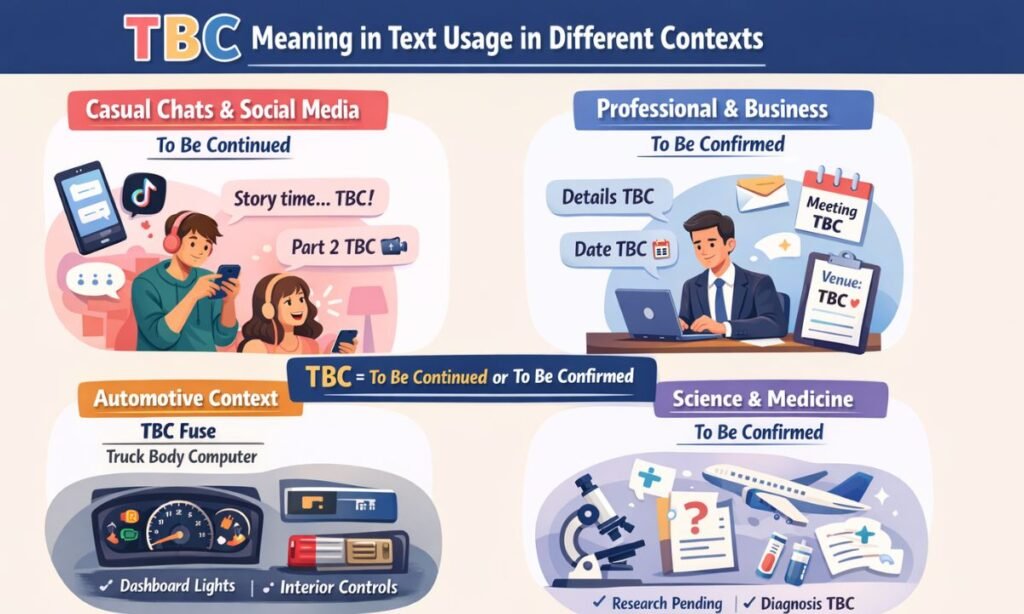
Context is the deciding factor with TBC. The same three letters behave differently depending on the platform and the relationship between sender and receiver.
TBC in Everyday Texting and Chats
In WhatsApp, iMessage, and Telegram conversations, TBC usually signals that a story, update, or reply will continue at a later point. It’s a way to keep a conversation thread open without rushing to finish.
Real-world examples:
- “So my boss called me into the office today TBC, I’ll explain tonight.”
- “Had the weirdest thing happen on the commute. TBC when I get home.”
It adds a bit of suspense to everyday exchanges and tells the other person: this isn’t over yet.
TBC on Social Media (Instagram, TikTok, Twitter/X)
Social media creators have fully adopted TBC as a content hook. It keeps audiences engaged between posts, videos, and announcements.
- TikTok: Multi-part videos regularly end with “TBC” in the caption, directing viewers to a Part 2.
- Instagram: Product teasers, event posts, and Story series use “TBC” next to dates or details not yet locked in.
- Twitter/X: Long-form threads sometimes end mid-argument or mid-story with “TBC” to drive follow-up engagement.
The effect is intentional it creates anticipation and keeps people coming back.
TBC in Professional and Business Settings
In business emails, project plans, meeting invites, and corporate documents, TBC almost exclusively means “To Be Confirmed.” It’s a clean, professional way to flag that a detail is tentative and will be updated once finalized.
Common usage examples:
- “The client review is scheduled for Thursday venue TBC.”
- “Q4 budget sign-off: TBC pending CFO approval.”
- “Keynote speakers for the summit: TBC.”
Using TBC in a business context shows organization. It tells recipients that you’re on top of the situation and will follow up rather than leaving them guessing.
TBC Meaning in Text Slang
Among younger audiences particularly Gen Z and late millennials TBC functions as versatile text slang in two main ways:
- Cliffhanger tool Ending a story mid-way in a group chat to build suspense before finishing later.
- Low-commitment signal Keeping plans open and flexible without outright saying no, which aligns with the casual, non-committal communication style common in youth culture.
It sits comfortably alongside abbreviations like TBH (to be honest), NGL (not gonna lie), and IRL (in real life) short, snappy, and universally understood by anyone who grew up texting.
TBC Fuse Meaning
Completely separate from texting, TBC in automotive terminology stands for “Truck Body Computer” more widely known as the Body Control Module (BCM) fuse.
Found primarily in General Motors vehicles (trucks, vans, and SUVs), the TBC fuse is responsible for:
- Dashboard indicator lights Controls warning lights and instrument panel displays
- Interior and dome lighting Protects cabin lights from electrical overload
- Electronic accessories Guards devices against dangerous current surges
The TBC fuse is a time-delay cartridge fuse, meaning it’s designed to absorb brief power spikes during engine start-up without blowing. It typically ranges from 10 to 20 amps, depending on the vehicle’s make and model.
Why does it blow? The three most common causes are:
- Electrical overload Too many accessories drawing power simultaneously
- Incorrect wiring A misconnected radio or aftermarket device (especially when a wire is incorrectly used as a ground)
- Loose or shorted wiring harness Particularly around fuel injectors
If your dome lights stop working or dashboard indicators flicker unexpectedly, a blown TBC fuse is often the first thing to check.
TBC Meaning Urban Dictionary
Urban Dictionary lists several community-submitted definitions for TBC, ranging from gaming references to regional slang. The most notable non-standard meaning is “The Burning Crusade” the second expansion pack for the MMORPG World of Warcraft, released in 2007. Among WoW players, this meaning is so embedded in gaming culture that TBC in a forum almost certainly refers to the expansion, not a conversation placeholder.
Other Urban Dictionary entries are humorous or hyper-local and have not entered mainstream usage. In everyday digital communication, the standard meanings “To Be Confirmed” and “To Be Continued” remain dominant.
TBC Meaning in Physics, Medical, and Aircraft Terminology
TBC appears across several specialized fields, each time carrying the same core idea of pending verification but with significantly higher stakes than in casual texting.
| Field | TBC Meaning | Practical Use |
| Physics | To Be Confirmed | Marks unverified experimental data or theoretical values in research papers and academic drafts |
| Medical / Clinical | To Be Confirmed | Used in patient reports, treatment plans, and clinical trial records where results are still pending |
| Public Health | Tuberculosis Control | Appears in WHO reports, public health policy documents, and TB prevention program names |
| Aviation / Aircraft | To Be Confirmed | Found in maintenance logs, flight schedules, and gate assignments for unverified operational data |
| Engineering / Construction | Top Back of Curb | Used in blueprints and survey plans to indicate a specific curb height measurement |
In aviation and medicine especially, unconfirmed details carry real-world consequences which is why TBC is used deliberately and precisely in those environments.
What Does TBC Mean for Movies?
TBC appears in film and entertainment in two distinct ways:
1. “To Be Continued” in storytelling You’ll see this at the end of multi-part films, TV season finales, or web series episodes. It’s a narrative device signaling that the story isn’t over the next chapter is coming.
2. “To Be Confirmed” in production and scheduling When a movie’s release date, cast, or filming location is listed as TBC on a studio announcement or event poster, it means that specific detail hasn’t been officially locked in yet.
Bonus: In UK cinemas, TBC can also stand for “To Be Classified” a legal placeholder that appears on posters before a film receives its official age rating from the British Board of Film Classification (BBFC).
Common Misconceptions About TBC
Several persistent misunderstandings circulate about TBC. Here’s the truth behind each:
| Misconception | Reality |
| “TBC always means To Be Continued” | In professional settings, it almost always means To Be Confirmed |
| “TBC means the event is canceled” | Not at all details are pending, nothing has been called off |
| “TBC is vague and unprofessional” | The opposite it’s a precise placeholder signaling organized, transparent communication |
| “TBC and TBD are interchangeable” | They’re related but meaningfully different (see comparison table below) |
| “TBC is a new internet slang term” | It originated in formal administrative and project management communication |
Similar Terms and Alternatives to TBC
Understanding TBC becomes much sharper when you compare it directly to its close relatives:
| Abbreviation | Full Form | Key Distinction |
| TBC | To Be Confirmed / Continued | Details exist but await official confirmation, OR a story isn’t finished yet |
| TBD | To Be Determined / Decided | No decision has been made yet the matter is still under evaluation |
| TBA | To Be Announced | A decision may exist internally but isn’t ready for public disclosure |
| TBR | To Be Resolved | A pending issue needs resolution before moving forward |
| TBP | To Be Provided | Specific materials or information will be supplied at a later date |
| TBW | To Be Written | Content is planned but hasn’t been created yet |
| WIP | Work In Progress | A task or project is actively being worked on right now |
The simplest rule of thumb:
- Decided but not finalized → TBC
- Not yet decided → TBD
- Decided but not yet public → TBA
Differences from Similar Words
The most commonly confused pairing is TBC vs. TBD. Here’s a concrete breakdown:
TBC (To Be Confirmed): A provisional decision has been made it just needs a final sign-off. Example: “The venue is the Grand Hotel, TBC.” (Hotel chosen; formal confirmation pending.)
TBD (To Be Determined): No decision has been reached yet the matter is still being assessed. Example: “The venue is TBD.” (Nobody has even shortlisted a location yet.)
TBA (To Be Announced): The decision is finalized internally but hasn’t been shared with the public yet. Example: “Venue TBA announcement coming Friday.”
Think of it as a decision pipeline: TBD → TBC → TBA from undecided, to decided-but-pending-confirmation, to confirmed-but-not-yet-public.
How to Respond to TBC?
The right response to TBC depends entirely on context:
When TBC = “To Be Confirmed” (plans, events, work):
- “Got it I’ll wait for the confirmed details before making arrangements.”
- “No problem, keep me posted once it’s locked in.”
- “Noted. Let me know when you have a final answer.”
When TBC = “To Be Continued” (storytelling, casual chats):
- “Don’t leave me hanging what happened next?”
- “I’m waiting! Tell me the rest when you can.”
- “Can’t wait for Part 2.”
When TBC appears in a professional email: Acknowledge it formally and establish a follow-up expectation: “Understood please update me once the details are confirmed so I can plan accordingly.”
The golden rule: match your response tone to the context. A cliffhanger in a group chat deserves playful curiosity. A TBC in a project schedule deserves a professional acknowledgment.
TBC in Online Conversations and Dating Apps
On platforms like Tinder, Bumble, and Hinge, TBC has found a natural home in early-stage communication. It strikes exactly the right balance between showing genuine interest and keeping things relaxed which is what most people want when getting to know someone new.
How it typically shows up:
- “Coffee this weekend? Details TBC depends on my shift.” (Shows interest without overcommitting)
- “Had such a weird day… TBC when we actually talk.” (Builds intrigue and invites deeper conversation)
- “The story about my friend’s wedding is definitely TBC on our first date.” (Playful teasing that creates a natural reason to meet)
In friend groups and social planning contexts, TBC serves a similar function it keeps options open without the awkwardness of “maybe” or “I’m not sure.” It’s polite, concise, and socially fluent in the language of digital-first relationships.
Frequently Asked Questions
What does TBC mean in a text message?
TBC means “To Be Confirmed” when referencing plans or pending details, or “To Be Continued” when a story or conversation isn’t finished yet.
Is TBC formal or informal?
Both it works in professional emails as “To Be Confirmed” and in casual texts as “To Be Continued,” making it one of the most flexible abbreviations in modern communication.
What’s the difference between TBC and TBD?
TBC means a decision exists but needs final confirmation; TBD means no decision has been made at all yet.
What does TBC mean on a movie poster or event listing?
Either the story continues in a future installment (“To Be Continued”), or a specific detail like the release date is unfinalized (“To Be Confirmed”). In UK cinemas, it can also mean “To Be Classified” before a film gets its age rating.
What does the TBC fuse control in a vehicle?
The TBC fuse (Truck Body Computer) protects the Body Control Module, managing interior lighting, dashboard indicators, and electronic accessories primarily found in GM vehicles.
Can TBC mean different things on TikTok vs. in a business email?
Yes on TikTok it signals “To Be Continued” (a follow-up video is coming), while in a business email it means “To Be Confirmed” (a detail is pending finalization).
How should I respond to TBC in a professional email?
Acknowledge it and request a follow-up: “Noted please keep me informed once the details are confirmed.”
Conclusion
Three letters. Dozens of applications. That’s the scope and occasional confusion of TBC.
Whether it closes a cliffhanger text from a friend, sits next to a date in a project timeline, ends a film season with dramatic flair, or quietly guards your car’s dome lights from electrical surges, TBC always signals the same underlying truth: something isn’t finished yet, but it will be.
Read the room, and you’ll always know which meaning applies. In formal or planning contexts, TBC = “To Be Confirmed.” In storytelling and casual conversation, TBC = “To Be Continued.” And in your GM vehicle’s fuse panel, TBC = your interior lighting’s unsung guardian.
Now that you’ve seen TBC in every context it appears, you’ll read it faster, respond smarter, and use it more confidently in your work emails, your group chats, and everywhere in between.

As the creator and primary voice of meaning drift, Thomos has spent the last 4 years deeply immersed in the pursuit and sharing of life’s meaning, helping thousands navigate questions of purpose amid uncertainty. Shaped by studies in existential psychology, comparative spirituality, and personal periods of profound questioning, their writing translates complex ideas into clear, compassionate guidance. After leaving a high-pressure professional path, they now dedicate themselves fully to exploring what makes life feel worth living. Thomos lives with curiosity and quiet intention, often found journaling at sunrise or in deep discussion with like-minded souls. Their core message: meaning is not a destinationit’s an ongoing, liberating act of creation available to everyone