
The word naive (also spelled naïve) is the go-to term in everyday English for someone who lacks worldly experience, is overly trusting, or accepts things without critical thought.
While it most commonly describes a person’s character or mindset, it also appears in specialized fields like biology, immunology, and art where it carries a more technical, neutral meaning. In informal speech, it can range from a gentle observation to a mild criticism.
What Does Naive Mean?
At its core, naive means lacking experience, judgment, or critical awareness. When someone is described as naive, it usually means they are too quick to trust people, accept information at face value, or underestimate the complexity of a situation. The word sits somewhere between innocence and foolishness and which side it leans toward depends entirely on context.
Merriam-Webster defines naive as “marked by innocence or simplicity; showing a lack of experience or knowledge.” Cambridge Dictionary adds that a naive person is “too ready to believe that someone is telling the truth or that life is simple and fair.”
What makes naive such a versatile word is that it does not always carry a negative charge. A child asking “why do people lie?” is being naive in the most endearing way. A politician dismissing complex geopolitical tensions as “easily solvable” is naive in a way that draws criticism.
Naive Person Meaning
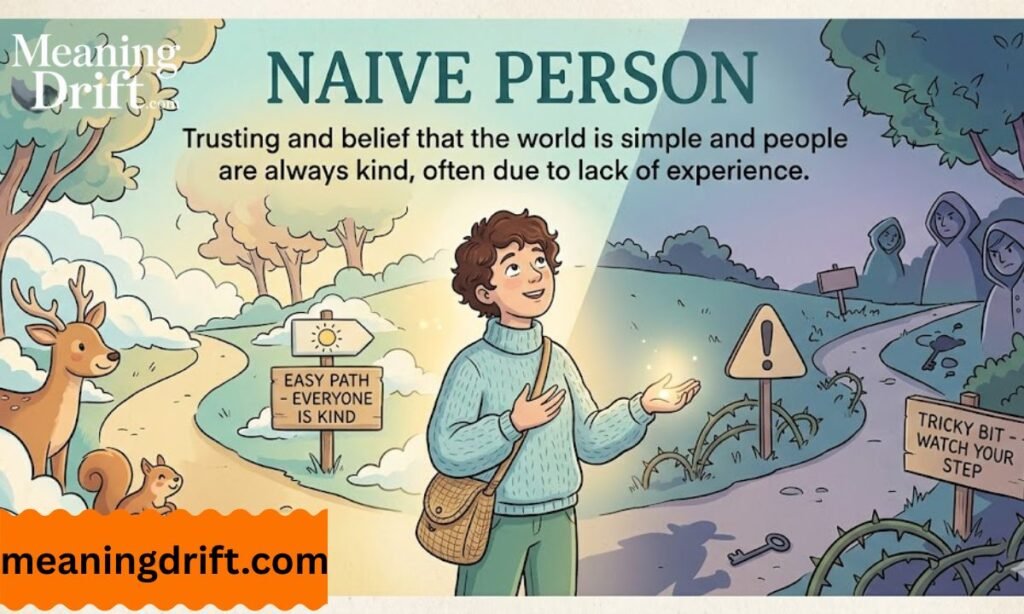
A naive person is someone who has not yet been “taught by experience.” They tend to:
- Take people’s words at face value without questioning motives
- Assume the best in every situation, sometimes to their own detriment
- Lack awareness of social manipulation, hidden agendas, or real-world complexity
- React with genuine surprise when things do not go as expected
It is important to note that being naive is not the same as being unintelligent. Many highly educated people can be naive about specific areas of life particularly those outside their expertise or personal experience.
Simple Definition of Naive in English
For learners of English, here is the simplest way to understand naive:
Naive = not yet taught by experience; too trusting or too simple in thinking.
| Word Form | Example |
| Adjective | “She gave a naive answer.” |
| Adverb | “He naively believed the stranger.” |
| Noun | “His naivety cost him the deal.” |
The noun forms naivety (British English) and naiveté (borrowed from French) both refer to the quality of being naive.
Naive Meaning in Biology
In science, especially immunology and biology, the word naive takes on a precise technical meaning that is entirely non-judgmental.
A naive cell most commonly a naive T cell or naive B cell refers to a lymphocyte that has matured and entered the bloodstream but has not yet encountered its specific antigen. In other words, it is an immune cell that is ready to act but has not yet been “activated” by a foreign pathogen.
Key points about naive cells in biology:
- Naive T cells exit the thymus fully formed but untriggered. Once they meet their target antigen, they differentiate into active effector or memory T cells.
- Naive B cells similarly circulate until they encounter a matching antigen, at which point they become antibody-producing plasma cells.
- In clinical research, a drug-naive patient refers to someone who has never been treated with a particular medication before.
- A vaccine-naive individual is someone who has not yet received a specific vaccine and therefore has no immune memory of that pathogen.
In this biological context, naive simply means “unexposed“ and it is a value-neutral, descriptive term used widely in medical and scientific literature.
Naive Meaning in Different Contexts
The beauty of the word naive is how naturally it adapts across different fields and situations.
In Everyday Life
Used to describe someone who is trusting to the point of being gullible. Example: “It was naive of him to leave his bag unattended at the airport.”
In Politics
Often used critically to describe oversimplified thinking. Example: “The proposal was dismissed as politically naive.”
In Art
Naïve art (also called primitive or folk art) refers to works created by self-taught artists without formal training. It is typically characterized by bold colors, flat perspectives, and childlike simplicity and is admired, not looked down upon.
In Psychology
Psychologists sometimes refer to naive realism the belief that one sees the world objectively and accurately, while others are biased. This is considered a cognitive blind spot most people share.
In Computer Science
A naive algorithm is a straightforward but inefficient solution to a problem used as a baseline before more optimized approaches are developed.
In Research
A naive subject or naive rater in a study is someone who is unaware of the experiment’s hypothesis, ensuring unbiased results.
Also Read This:Manifest Meaning in English: Simple Definition With Examples
Naive Meaning Example
Here are real-world scenarios that show how the meaning of naive plays out in practice:
Scenario 1: A teenager gives money to a stranger who promises to double it by the next day. → This is a classic example of naive trust a lack of experience with deception.
Scenario 2: A diplomat assumes that all parties in a conflict want peace. → This is political naivety oversimplifying a complex, multi-interest situation.
Scenario 3: An art gallery displays colorful village paintings by an untrained rural artist. → This is naïve art valued for its unpolished authenticity.
Scenario 4: A medical trial tests a drug on naive patients to avoid prior-treatment bias. → This is the biological/clinical use of the term purely technical and neutral.
Examples of Naive in Sentences
Below are 10 natural sentences using naive in different ways:
- “I was young and naive when I first moved to the city.”
- “It’s naive to think that hard work alone guarantees success.”
- “She gave a naive smile, clearly unaware of the tension in the room.”
- “The scientist used naive mice those never exposed to the virus in the control group.”
- “His naiveté made him easy to manipulate.”
- “We naively believed the project would be finished on time.”
- “She asked a lot of naive questions, but that’s how she learned.”
- “The plan looks good on paper, but it’s politically naive.”
- “His naive confidence was almost refreshing in a room full of cynics.”
- “Drug-naive patients showed a stronger response to the initial treatment.”
Is Being Naive Good or Bad?
The honest answer: it depends.
When naivety can be harmful:
- It makes you vulnerable to manipulation, scams, and broken trust.
- It can lead to poor decisions in business, politics, or relationships.
- Chronic naivety in adulthood may signal an unwillingness to learn from experience.
When naivety can be a strength:
- It often comes with openness, enthusiasm, and a willingness to try things others have given up on.
- Naive optimism can fuel creativity and innovation many great ideas started with someone naive enough to think they could change the world.
- In relationships, a degree of trust and good faith (closely linked to naivety) is actually healthy.
The key distinction is whether the naivety is temporary and age-appropriate or persistent despite clear evidence to the contrary. Growing through naivety is part of maturity; never growing out of it can become a liability.
Difference Between Naive and Innocent
These two words are often used interchangeably, but they are not the same.
| Feature | Naive | Innocent |
| Core meaning | Lacks experience or worldly knowledge | Free from guilt or wrongdoing |
| Tone | Can be mildly critical | Mostly positive or neutral |
| Focus | Judgment and awareness | Moral purity |
| Example | “She was naive to trust him.” | “He was innocent of the crime.” |
| Permanence | Usually changes with experience | Often describes a fixed state (legal, moral) |
In short: an innocent person may not have done anything wrong; a naive person simply does not yet know how things work. A child can be both at once. An adult can be innocent (morally blameless) without being naive.
Synonyms and Antonyms of Naive
Synonyms (words with similar meaning):
- Gullible – easily deceived
- Ingenuous – openly honest, without hidden motives
- Artless – simple and natural, without cunning
- Credulous – too ready to believe
- Unsophisticated – lacking social or worldly experience
- Green (informal) – new and inexperienced
- Trusting – having too much faith in others
Antonyms (words with opposite meaning):
- Sophisticated – worldly and experienced
- Cynical – distrustful and doubtful of good motives
- Shrewd – sharp and practical in judgment
- Worldly – experienced in the ways of the world
- Skeptical – questioning and not easily convinced
- Wary – cautious and watchful
How to Pronounce Naive Correctly
Naive is pronounced: nah-EEV (/naɪˈiːv/)
Many English speakers mispronounce it as “NAY-ive” (rhyming with “wave”), but the correct stress falls on the second syllable.
- The accent mark version, naïve, uses a diaeresis (the two dots) to show that the two vowels are pronounced separately: na-EEV, not nayv.
- The related noun naivety is pronounced: nah-EEV-uh-tee
- The French-origin noun naiveté is pronounced: nah-EEV-uh-TAY
A quick tip: think of the word as two syllables “nah” + “eev” and you will always get it right.
Common Mistakes When Using Naive
Even native English speakers trip up with this word. Here are the most frequent errors:
- Spelling it as “niave” or “naieve” The correct spelling is naive (or naïve with the accent).
- Using it as an insult Naive is descriptive, not inherently contemptuous. Tone and context matter.
- Confusing naïve with ignorant Ignorance is a lack of knowledge; naivety is a lack of worldly experience. A person can be very knowledgeable but still naive in how they apply that knowledge to real-life situations.
- Overusing it to dismiss ideas Calling an argument “naive” without explanation can be a lazy rhetorical move. Be specific.
- Forgetting its positive uses In art, biology, and psychology, naive is a neutral or even favorable term. Do not always assume it is critical.
Frequently Asked Questions About Naive Meaning
What is the simplest definition of naive?
Naive means lacking experience or being too trusting not yet aware of how the world really works.
Is naive a negative word?
Not always. It can be a gentle observation, a mild criticism, or even a compliment depending on context (especially in art and science).
What is the difference between naive and gullible?
Gullible specifically means easily deceived; naive is broader and includes general inexperience, not just susceptibility to tricks.
How do you spell the plural or noun form?
The noun forms are naivety (British) or naiveté (French-influenced). There is no plural of the adjective itself.
What does naive mean in immunology?
A naive cell (like a naive T cell) is one that has not yet been exposed to its target antigen fully formed but not yet activated.
Can adults be naive?
Yes. Anyone can be naive about areas outside their experience, regardless of age or education.
Is naivety a sign of low intelligence?
No. Naivety reflects a gap in experience, not intellect. Many brilliant people are naive about areas outside their expertise.
Where does the word naive come from?
From French naïf/naïve, derived from Latin nativus, meaning “native” or “natural.”
Final Thoughts on Naive Meaning
The word naive is more layered than it first appears. In everyday speech, it gently (or not so gently) points out someone’s lack of experience or over-trusting nature. In science, it is a precise, neutral descriptor for unexposed cells or subjects. In art, it describes work that is valued because of its unschooled simplicity.
Understanding this word fully means recognizing its range from the child who believes every promise to the immunologist describing an untriggered T cell. Naivety is not a permanent flaw. More often than not, it is simply the starting point before experience, observation, and a few hard lessons do their work.
Whether you are studying for an English exam, expanding your vocabulary, or just curious about a word you keep encountering, knowing the full spectrum of naive meaning will make you a sharper, more confident communicator.

Thomas is the creator of MeaningDrift, a writer guided by curiosity and a passion for meaning. With a background in existential psychology and comparative spirituality, Thomos translates deep questions into clear, compassionate guidance. Their writing invites readers to explore life’s purpose and craft meaning in everyday moments.