

Have you ever typed “resignate” mid-sentence and wondered if it was actually a word? You are not alone. This slip appears in emails, social media posts, and even professional presentations every single day. The resignate or resonate confusion is one of the most common vocabulary mistakes in modern English and it has a surprisingly simple answer. Only one of these words exists. The other is a phantom. By the end of this guide, you will know exactly which is correct, where it comes from, what it means, and how to use it with total confidence.
The Core Confusion: Resignate vs Resonate
At first glance, “resignate” feels like a legitimate word. It sounds formal. It fits the pattern of verbs like designate, navigate, and originate. The brain even links it to familiar words like resignation and resign, both of which are real and widely used.
But here is the truth: “resignate” does not exist in standard English. It has never appeared in any major dictionary. No grammar authority recognizes it. It is what linguists call a “nonstandard formation” a word that feels right because of familiar patterns but has no actual foundation in the language.
The confusion is easy to explain:
- Sound similarity: “Resignate” and “resonate” sound nearly identical in casual speech, especially at speed.
- Pattern borrowing: English builds many verbs with the -ate suffix. People naturally assume the same must apply here.
- Viral repetition: Once a public speaker or influencer uses the wrong word, audiences hear it, internalize it, and repeat it.
The result is that “resignate” quietly spreads through writing and conversation while “resonate” the powerful, correct word gets sidelined.
Unlocking the Correct Word: Resonate
Resonate is the word you want every single time. Whether you are describing a song that fills a room, an idea that stirs emotion, or a message that stays with an audience long after it is delivered resonate is the right choice.
It functions as a verb and can be used in both literal and figurative senses:
- Literal: relating to sound that echoes, reverberates, or amplifies through a space.
- Figurative: relating to ideas, emotions, or experiences that connect deeply with a person.
Pronunciation: /ˈrez.ə.neɪt/ emphasis on the first syllable. Notice: it begins with rez, not rez-ig. Keeping that first syllable clear in your mind is one of the easiest ways to avoid the error.
Quick memory trick: Break it down as re-sonate “to sound again.” That mental image of an echo or reverberating sound makes the correct spelling stick.
Etymology & Historical Roots
Understanding where resonate comes from removes any remaining doubt about which word is real.
resonate traces back to the Latin verb resonare, built from two parts: re- (again) and sonare (to sound). The literal meaning was “to sound again” or “to echo” the acoustic quality of a sound bouncing back through space.
- The word entered Middle English around the 14th century, initially tied to literal sound and reverberation.
- Its first recorded use in English dates to approximately 1873 in the context of acoustics.
- By the 16th century, writers began applying it figuratively to ideas that “echo” in the mind, emotions that linger, and messages that endure.
- By the 1980s, political writer William Safire noted that resonate had become a “vogue word” used so frequently across culture, business, and media that its usage had “gone out of control.”
Why “resignate” has no roots: There is no Latin, Greek, Middle English, or Old French equivalent. It simply does not exist in the historical record of the language.
Resonate With Me Meaning

When someone says “that really resonates with me,” they mean the idea, experience, or emotion connects with something personal a memory, a belief, a feeling they recognize. It goes beyond mere agreement. To resonate is to strike a chord at a deeper level.
Think of it this way: a guitar string resonates when it vibrates at just the right frequency. In the same way, a story or message resonates with a person when it vibrates at the frequency of their own experience.
Common scenarios where this phrase applies:
- A motivational speech that mirrors your personal journey
- A film that reflects your own struggles back at you
- A poem whose imagery feels like it was written for your life
The phrase suggests authenticity, emotional depth, and genuine connection which is why it is so widely used in communication, marketing, leadership, and the arts.
Also Read This:Snowball Kiss Meaning: What It Really Means and Why People Do It
Resignate or Resonate Examples

The clearest way to understand the difference is to see both in action. The table below contrasts incorrect and correct usage:
| Incorrect (Resignate) | Correct (Resonate) |
| Her speech resignated with the crowd. | Her speech resonated with the crowd. |
| I hope this resignates with you. | I hope this resonates with you. |
| The idea resignated deeply. | The idea resonated deeply. |
| His story really resignated with me. | His story really resonated with me. |
| The music resignated through the hall. | The music resonated through the hall. |
Notice: every single instance of “resignate” looks and reads as an error. “Resonate” slots in cleanly every time.
Resignate or Resonate Meaning
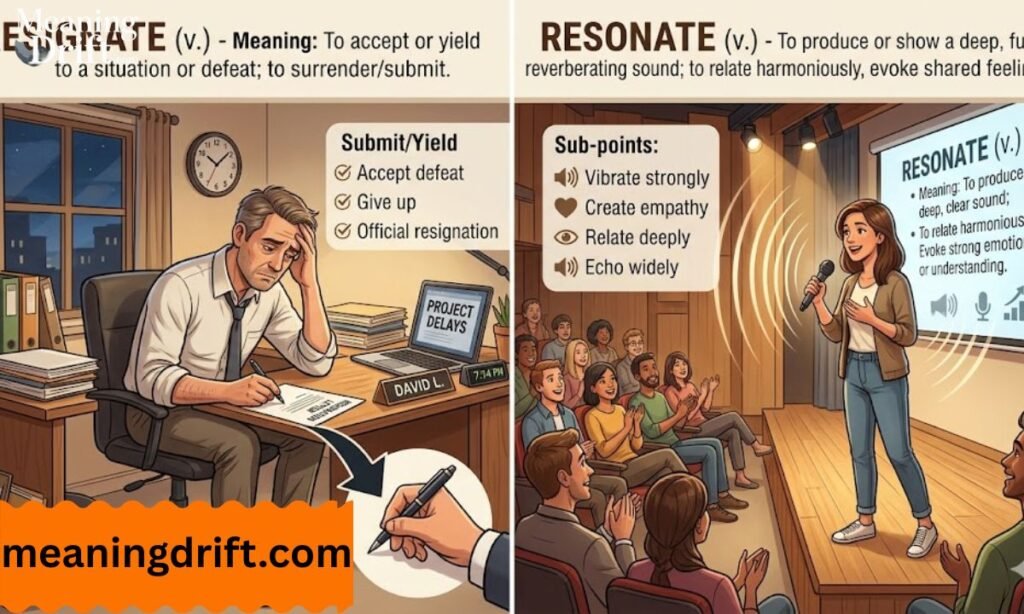
To summarize the distinction clearly:
- Resignate: Not a word. Has no dictionary definition. Using it signals a vocabulary error.
- Resonate: A well-established English verb meaning to produce an echoing sound or, figuratively, to evoke strong emotion, connection, or lasting impact in a person or audience.
They are not interchangeable. They are not synonyms. One exists; one does not.
Resonate With Someone Usage Patterns
The phrase resonate with someone is arguably the most common form of this verb in modern English. It implies that a message, idea, or experience connects personally with a specific individual or group.
Common structures:
- Something resonates with someone (The campaign resonated with younger voters.)
- Something resonates (Her words still resonate today.)
- Something resonated (The story resonated because it felt real.)
- Something is resonating (This message is resonating across communities.)
The word works across tenses, audiences, and registers from corporate boardrooms to creative writing.
What Dictionaries Say
No ambiguity exists here. The world’s leading language authorities are unanimous:
Merriam-Webster defines resonate as: “to produce or be filled with a deep, full, reverberating sound; to relate harmoniously; to have a repetitive pattern that resembles resonance; to produce a continuing and enduring effect.”
Oxford English Dictionary defines it as: “to have particular meaning or importance for someone; to affect or appeal to someone in a personal or emotional way.”
Cambridge Dictionary describes it as: “to cause someone to think of something similar, or have an emotional effect on someone.”
On “resignate”: Not a single major dictionary Merriam-Webster, Oxford, Cambridge, Collins, or Macmillan lists it as a valid English word. It does not appear even as an informal or dialectal variant.
Common Contexts & Usage Patterns
Resonate appears across virtually every field of modern communication. Here is how it functions in different contexts:
In marketing and branding: Messages that resonate with a target audience build trust, loyalty, and emotional connection. Campaigns rooted in authentic storytelling consistently outperform generic messaging.
In education: Teachers aim to present concepts in ways that resonate with students connecting new material to what learners already know and care about.
In leadership: Effective leaders craft visions that resonate with their teams, giving people a reason to invest emotionally and professionally in shared goals.
In the arts: Musicians, filmmakers, and authors describe work as resonant when it reflects universal human experiences grief, love, hope, identity that outlast the moment of creation.
In personal conversation: Someone sharing advice says, “I hope this resonates with you” to mean: I hope this connects with something true in your own life.
Why Proper Usage Matters
Using the wrong word is never just a spelling issue. It carries real consequences for how you are perceived.
Credibility: In a job interview, a pitch meeting, or a published article, saying “resignate” signals carelessness with language which can cast doubt on your attention to detail more broadly.
Clarity: “Resignate” carries no meaning for listeners or readers. It introduces a moment of confusion that breaks the flow of communication.
Emotional impact: Resonate is a word people feel. It evokes depth, connection, and lasting effect. “Resignate” evokes nothing at all.
The fix is simple and the payoff is significant: replace “resignate” with “resonate” every time.
Examples in Media, Literature, & Pop Culture
Resonate is one of the most powerful and widely used words in contemporary expression. A few examples of how it appears in serious contexts:
- Literature: The themes of compassion and injustice in To Kill a Mockingbird have resonated with generations of readers across cultures and decades.
- Music: Critics frequently describe albums as resonant when the lyrics and melodies reflect emotional truths that outlast a single listening.
- Film: A movie resonates when its characters face struggles the audience has lived through themselves.
- Politics: Campaign messages that resonate win elections; those that feel hollow or disconnected lose them.
- Public speaking: The most memorable speeches from Martin Luther King Jr. to graduation addresses resonate because they speak to shared human experience, not just information.
Each of these uses relies on resonate carrying emotional and intellectual weight. “Resignate” could never fill that role.
Crafting Messages That Resonate
Knowing the word is one thing. Actually writing messages that resonate with people is a craft. Here is how to do it:
- Lead with the human, not the product. People connect with stories, not features. Start with the experience or emotion you want your audience to recognize in themselves.
- Use specific, concrete language. Abstract words rarely resonate. Specific details a moment, a person, a place make people feel something real.
- Keep it simple. Complicated language builds distance. Clear, direct language builds connection.
- Reflect the audience’s world back to them. Messages resonate when they mirror what the listener already believes, values, or has experienced.
- Leave a lasting image. The best messages plant a single, vivid idea that stays in the mind long after the conversation ends.
Whether you are writing an email, a speech, a campaign, or a conversation opener these principles help ensure your words resonate, not just land.
Quick Practice Section
Test your understanding before you go. Choose the correct word for each sentence.
Fill in the blank (resignate / resonate):
- The teacher’s advice really ________ with her students.
- I hope this idea ________ with the team.
- The sound of the bell ________ throughout the quiet hallway.
- His personal story ________ deeply with the audience.
Answers: All four answers are resonated or resonates depending on tense. “Resignate” is never correct in any of these sentences.
Error correction exercise:
- ❌ “I hope my proposal resignates with you.”
- ✅ “I hope my proposal resonates with you.”
- ❌ “Her message resignated across social media.”
- ✅ “Her message resonated across social media.”
Once you have corrected it a few times consciously, the right word becomes automatic.
Frequently Asked Questions
Is “resignate” a real word?
No. It does not appear in any standard English dictionary and is considered an error in both formal and informal writing.
What does “resonate” mean?
It means to produce an echoing or reverberating sound (literal), or to connect deeply with someone emotionally or intellectually (figurative).
Why do people say “resignate” instead of “resonate”?
Because the two words sound similar in speech, and “resignate” follows familiar English word patterns even though it has no actual basis in the language.
Can “resonate” be used in formal writing?
Absolutely. It is widely accepted across academic, professional, journalistic, and creative writing contexts.
What are good synonyms for “resonate”?
Depending on context: connect, echo, strike a chord, strike home, linger, endure, reverberate, ring true.
Conclusion
The answer to resignate or resonate is always the same: resonate. It is the only real word, the only one backed by centuries of linguistic history, and the only one that carries genuine meaning. “Resignate” is a phantom plausible in sound, nonexistent in substance.
Every time you want to say that something connects, echoes, stirs emotion, or leaves a lasting impression resonate is the word you need. Use it with confidence, and your writing will not just be correct. It will be powerful.

Thomas is the creator of MeaningDrift, a writer guided by curiosity and a passion for meaning. With a background in existential psychology and comparative spirituality, Thomos translates deep questions into clear, compassionate guidance. Their writing invites readers to explore life’s purpose and craft meaning in everyday moments.