

In the digital lexicon of 2026, ISTG remains a powerhouse acronym standing for “I Swear To God.” It serves as a linguistic anchor in text-heavy conversations, used primarily to emphasize the absolute truth of a statement or to convey a deep sense of exasperation.
While its roots are grounded in traditional swearing, its modern application is more about emotional intensity than religious invocation. Whether a user is trying to convince a skeptical friend or venting about a minor inconvenience, the term signals that the speaker is being 100% serious in that moment.
Understanding the nuance of ISTG is essential for navigating social media platforms like TikTok and X, where brevity is king. It can appear in lowercase for casual emphasis or uppercase to signal genuine frustration, making it a versatile tool for digital expression in our fast-paced communication culture.
What Does ISTG Mean in Text? 🤔
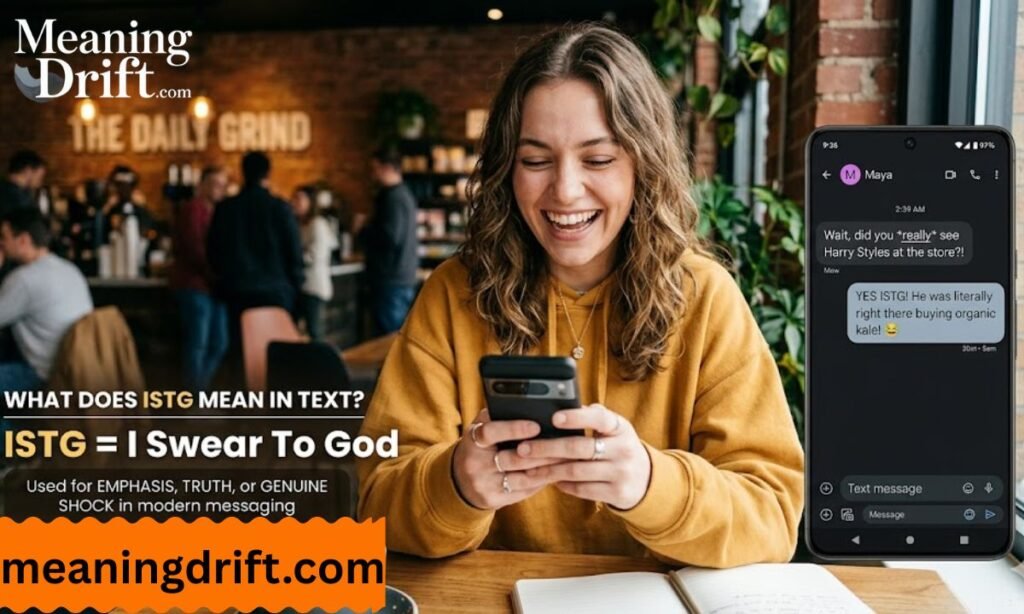
You’re scrolling through messages and you see it ISTG sitting there like a secret code. Don’t worry, you’re not alone. Millions of people search “what does ISTG mean” every month, and by the end of this article, you’ll know exactly what it means, where it came from, and how to use it like a pro.
ISTG meaning is simple: it stands for “I Swear To God.” It’s a four-letter acronym used in texting, social media captions, group chats, and DMs to add strong emotional emphasis to a statement whether that’s frustration, sincerity, excitement, or dramatic effect.
Think of ISTG as a digital exclamation point. Without it, a sentence feels flat. With it, the emotion hits harder instantly and effortlessly.
Core Meanings of ISTG in Texting 💬
The ISTG meaning doesn’t lock into just one emotion. Context shapes everything. Here are the four most common ways people use it:
| Emotional Use | Example | What It Signals |
| Expressing sincerity | “ISTG I didn’t eat your food” | Genuine honesty or promise |
| Showing frustration | “ISTG if he’s late again…” | Annoyance or warning |
| Adding dramatic emphasis | “ISTG this pizza is life-changing” | Hyperbole or excitement |
| Sarcasm | “Oh ISTG you’re such a great driver 🙄” | Playful mockery |
The tone shifts depending on the relationship between the senders, punctuation used, and emojis attached. A message with “ISTG 😭” reads very differently from “ISTG.” alone.
Origin of ISTG 🕰️
The phrase “I Swear To God” has existed for centuries as a spoken way to stress honesty. The abbreviation ISTG, however, is a product of the digital age. In the early 2000s, AOL Instant Messenger and SMS texting created a culture where speed mattered and character limits were real constraints. Long phrases got compressed. LOL, OMG, BRB and eventually ISTG became standard shortcuts.
By the early 2010s, platforms like Twitter, Tumblr, and Snapchat pushed abbreviations even further into mainstream youth culture. ISTG followed the same trajectory. By 2026, it’s firmly embedded in Gen Z and Millennial digital vocabulary across every major platform.
ISTG Meaning in Text vs Real Life Speech
In real life, people say “I swear to God” out loud usually with a raised voice or a dramatic pause. In texting, ISTG does the same job with four keystrokes. The difference is that written text has no tone of voice, so ISTG carries the emotional weight that a raised eyebrow or a dramatic sigh would carry in person.
That’s what makes ISTG so useful and occasionally so easy to misread. A message like “ISTG I’m serious” can feel warm and reassuring between close friends, but threatening or aggressive to someone who doesn’t know the sender well.
ISTG Meaning from a Boy
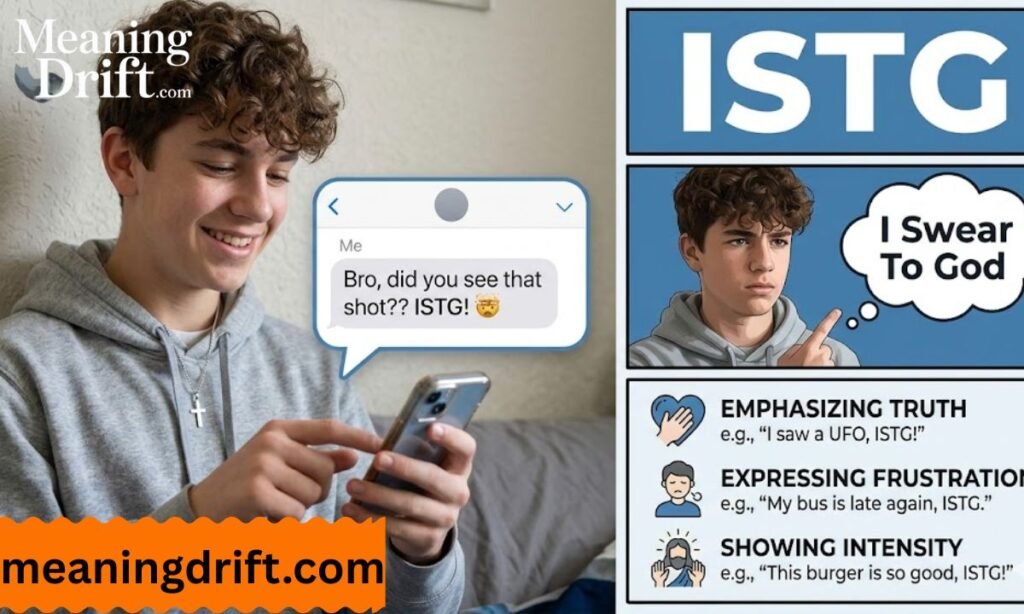
When a boy uses ISTG in a message, it usually signals that he wants to be believed or taken seriously. Males most commonly deploy it when defending themselves, making promises, or venting frustration about something that went wrong.
- “ISTG bro, I was there on time” wanting to clear up a misunderstanding
- “ISTG if this game lags one more time…” expressing gaming frustration
- “ISTG she looked right at me” dramatic storytelling to friends
It tends to feel direct and no-nonsense. The emotional range is narrower mostly earnestness or irritation rather than playful exaggeration.
Also Read This:WRD Meaning in Text: What It Really Stands For and How to Use It
ISTG Meaning from a Girl
Girls use ISTG with a wider emotional range. It shows up in sincerity, playful drama, genuine frustration, and affectionate teasing all in the same day.
- “ISTG you’re the most annoying best friend ever 😂” affectionate sarcasm
- “ISTG if he texts me one more time 🙄” exasperated frustration
- “ISTG this sunset is everything 🥹” genuine awe or emotion
The meaning depends less on gender and more on context, but ISTG from a girl is often paired with emojis to clarify tone which makes it easier to read correctly.
ISTG Meaning on Instagram
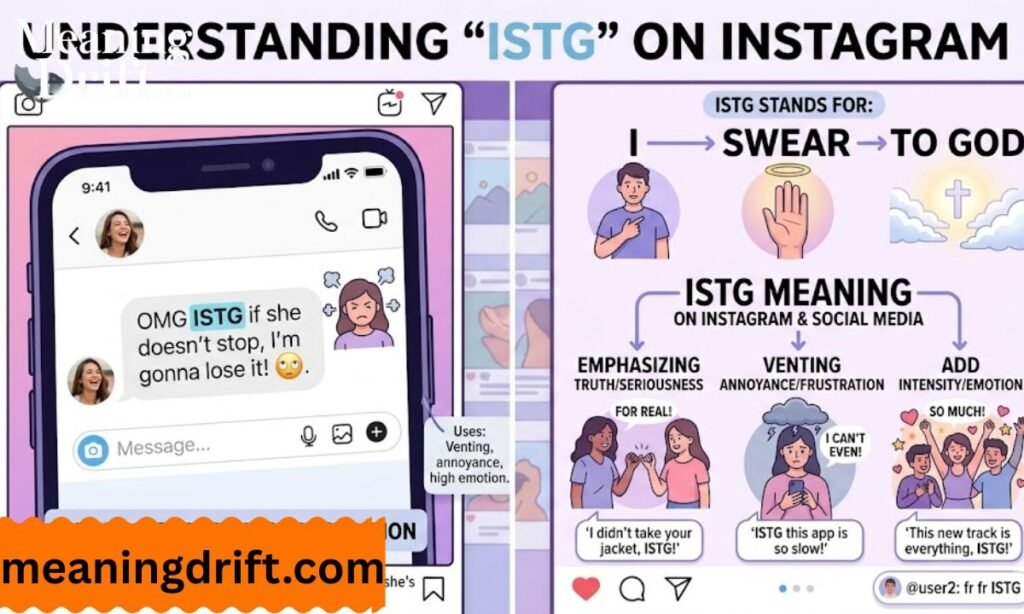
On Instagram, the ISTG meaning stays the same “I Swear To God” but the setting shifts how it lands. It appears in captions, story replies, and DMs, almost always paired with emojis to signal tone to a broader audience.
Popular Instagram uses include:
- Under aesthetic posts: “ISTG this view is unreal 🌅”
- Fan reactions: “ISTG her outfit slapped every single look”
- Story replies: “ISTG I screamed when I saw this”
One important clarification: ISTG is not short for Instagram. Instagram is abbreviated as IG. The similarity confuses some people, but they are completely unrelated acronyms.
ISTG Meaning Bridgerton Viral Moment 🎬
In early 2026, ISTG took an unexpected pop culture turn thanks to Bridgerton actor Luke Thompson. During a press interview, Thompson was asked to read a fan compliment about his co-star Yerin Ha that included the word “ISTG.” Instead of saying the acronym, he read it phonetically as “Istg” and when asked what it meant, he confidently said: “Instagram.”
Yerin Ha’s reaction absolute hysterical laughter instantly went viral. The clip exploded across TikTok, Twitter/X, and Instagram, turning ISTG into one of the most discussed slang terms of early 2026. Netflix UK even updated their Instagram bio to “welcome to our ISTG page” as a nod to the moment, and Netflix launched a limited-edition Bridgerton embroidered hat referencing the joke.
The meme reinforced how mainstream ISTG already was and gave it a fresh wave of cultural relevance.
How ISTG Is Commonly Used in Messages 📲
ISTG is flexible. It works at the beginning, middle, or end of a sentence. Here’s a quick breakdown of common placement patterns:
- Beginning: “ISTG, if you do that again…” sets an intense tone upfront
- End: “I passed the exam ISTG” adds surprise or disbelief at the close
- Standalone: “ISTG.” communicates deep exasperation with zero extra words
It shows up most frequently in group chats, Snapchat streaks, Instagram DMs, and TikTok comments where fast, punchy communication is the norm.
Real-Life Examples of ISTG in Text 📝
Here are natural examples across different situations:
- “ISTG I studied for five hours and still blanked” expressing genuine frustration
- “This cat just knocked my drink over ISTG 😭” venting about a relatable moment
- “ISTG you are the sweetest person I know” sincere compliment
- “ISTG if they cancel the show I’m done” fan outrage
- “ISTG she didn’t even apologize” recounting a drama to a friend
Emotional Tones of ISTG 🎭
ISTG carries at least five distinct emotional tones depending on context:
- Sincerity genuine honesty or a promise
- Frustration annoyance that has reached a tipping point
- Excitement hyperbole used to express delight
- Sarcasm the opposite of what is literally said
- Warning a calm-but-serious “don’t push me” energy
Reading the correct tone requires looking at the full message, the emoji used, and the relationship between the two people. Missing context is the most common reason ISTG gets misread.
ISTG vs Similar Slang Terms
| Term | Stands For | Key Difference |
| ISTG | I Swear To God | Emphasizes truth, frustration, or intensity |
| OMG | Oh My God | Surprise or shock less about honesty |
| FR | For Real | Confirms agreement or truth |
| TBH | To Be Honest | Softens a candid opinion |
| NGL | Not Gonna Lie | Admits something reluctantly |
| ONG | On God | Similar to ISTG swears truth |
ISTG carries the strongest emotional charge of this group. It’s more intense than FR, more personal than OMG, and more assertive than TBH.
Is ISTG Offensive? ⚠️
For most people in casual digital settings, ISTG is completely harmless slang. However, context matters:
- In formal environments (work emails, school submissions), it reads as careless or unprofessional.
- For religious audiences, casually invoking God can feel disrespectful.
- When misread without emojis, it can sound aggressive even when the sender meant it lightly.
The safest rule: use ISTG only with people you know well, in informal spaces, and always pair it with an emoji if there’s any chance of misinterpretation.
How to Respond When Someone Says ISTG
Your response depends entirely on the emotional tone they’re using. Here’s a quick guide:
- If they’re being sincere: “I believe you” / “I know, I know”
- If they’re frustrated: “Okay, I hear you” / “That sounds rough”
- If they’re being dramatic/excited: Match the energy “ISTG same 😭”
- If you’re unsure of the tone: Use a neutral, warm reply and let the conversation develop
Never assume ISTG is aggressive if you’re not sure. Ask or mirror the energy lightly.
ISTG in Social Media Captions
On public platforms, ISTG adds personality and relatability to captions. It signals that the creator is speaking casually and directly like a friend, not a brand. That’s why it performs well for content creators looking to build authentic engagement.
Good examples for captions:
- “ISTG this is the best thing I’ve cooked all year 🍝”
- “ISTG every day in this city hits different ☀️”
Avoid using ISTG in captions for professional pages, corporate accounts, or content aimed at mixed-age or conservative audiences.
Who Uses ISTG the Most? 👥
ISTG is most popular among:
- Gen Z (ages 13–27): The primary user base; used across all platforms daily
- Millennials (ages 28–40): Regular users, especially on Twitter/X and Instagram
- Fandom communities: Heavily used in fan reactions to TV shows, music, and sports
- Gamers: Common in gaming chats and Discord servers when reacting to big moments
Parents of teens are the most likely group trying to decode ISTG for the first time which explains why parental guides about the term are among the most-read articles on the topic.
Do’s and Don’ts of Using ISTG
Do:
- Use it in casual conversations with close friends
- Pair with emojis when tone might be unclear
- Use it to add emphasis when you genuinely mean what you’re saying
Don’t:
- Use it in professional, academic, or formal settings
- Send it without context in a tense conversation
- Overuse it frequent use dilutes the emotional impact
Why ISTG Became Popular
Three forces drove ISTG from niche shorthand to mainstream slang:
- Speed culture: Texting and social media reward brevity. Four letters beat seventeen.
- Emotional expression: Digital communication lacks vocal tone ISTG fills that gap instantly.
- Social media amplification: TikTok, Twitter, and the 2026 Bridgerton meme gave it massive cultural moments that introduced it to new audiences worldwide.
Psychology Behind ISTG Usage
From a language psychology standpoint, ISTG serves as a credibility signal. When someone feels they aren’t being believed, they reach for emphasis tools in speech, it’s a raised voice or eye contact; in text, it’s ISTG. It’s a digital equivalent of saying, “No, really I mean this.”
It also functions as an emotional release valve. Typing ISTG when frustrated is cathartic. It externalizes the feeling without requiring a lengthy explanation. In cognitive terms, it lowers the effort cost of emotional communication which is exactly why it spread so quickly in a world of instant messaging.
FAQs
What does ISTG mean in text?
ISTG stands for “I Swear To God” used to emphasize honesty, frustration, or strong emotion in messages.
What does ISTG mean?
It means “I Swear To God,” used as an emotional intensifier in digital conversations.
Is ISTG the same as Instagram?
No. Instagram is abbreviated as IG. ISTG is a completely separate acronym meaning “I Swear To God.”
What does ISTG mean from a boy?
Usually a sincere promise, a frustrated reaction, or wanting to be believed typically more direct and serious in tone.
What does ISTG mean from a girl?
A wider range sincere emotion, playful drama, frustration, or affectionate teasing, often paired with emojis.
What does ISTG mean on Instagram?
The same as in texts: “I Swear To God.” Used in captions and comments to add emotional emphasis or relatability.
What is the ISTG Bridgerton connection?
Bridgerton actor Luke Thompson went viral in 2026 for not knowing ISTG meant “I Swear To God” he thought it was Instagram, turning ISTG into a pop culture meme overnight.
Is ISTG offensive?
Not generally, but it can feel inappropriate in formal, religious, or mixed-audience contexts. Use wisely.
Do people still use ISTG in 2026?
Absolutely. It remains one of the most widely used texting acronyms, especially among Gen Z and Millennial users.
Conclusion
The ISTG meaning is simple on the surface “I Swear To God” but the way people use it is layered, flexible, and emotionally intelligent. It’s a sincerity marker, a frustration signal, a dramatic punchline, and a pop culture reference all wrapped into four letters.
Whether you’re trying to decode a message from a friend, level up your texting vocabulary, or just understand why the entire internet was quoting a confused Bridgerton actor in early 2026, now you have everything you need. ISTG, this guide covers it all. 😄

Thomas is the creator of MeaningDrift, a writer guided by curiosity and a passion for meaning. With a background in existential psychology and comparative spirituality, Thomos translates deep questions into clear, compassionate guidance. Their writing invites readers to explore life’s purpose and craft meaning in everyday moments.